Sary Zananiri
“On making and unmaking with Kia Zand”
To write about an unmade project is to write about its future potentials. And yet, to consider future potentials in the current moment is to be at odds with a world replete with such vast levels of humanitarian and ecological crisis. For an artist invited to make an intervention in such a world requires navigating layers of uncomfortable questions about ethics.
Speaking with artist Kia Zand about his project over the last year, the work has been through several iterations. A first ideation was an installation using vestiges of marble remnants, rough hewn and strewed across the floor forming a broken plane. It spoke to a monumental unmaking, while proposed hidden microphones picked up on the gratings sounds of rock-on-rock allowing stones to speak through their own unbearable weight. Later, this unmaking was found too disturbing at a time when landscapes – both ancient and modern – are being so quickly reduced to rubble.
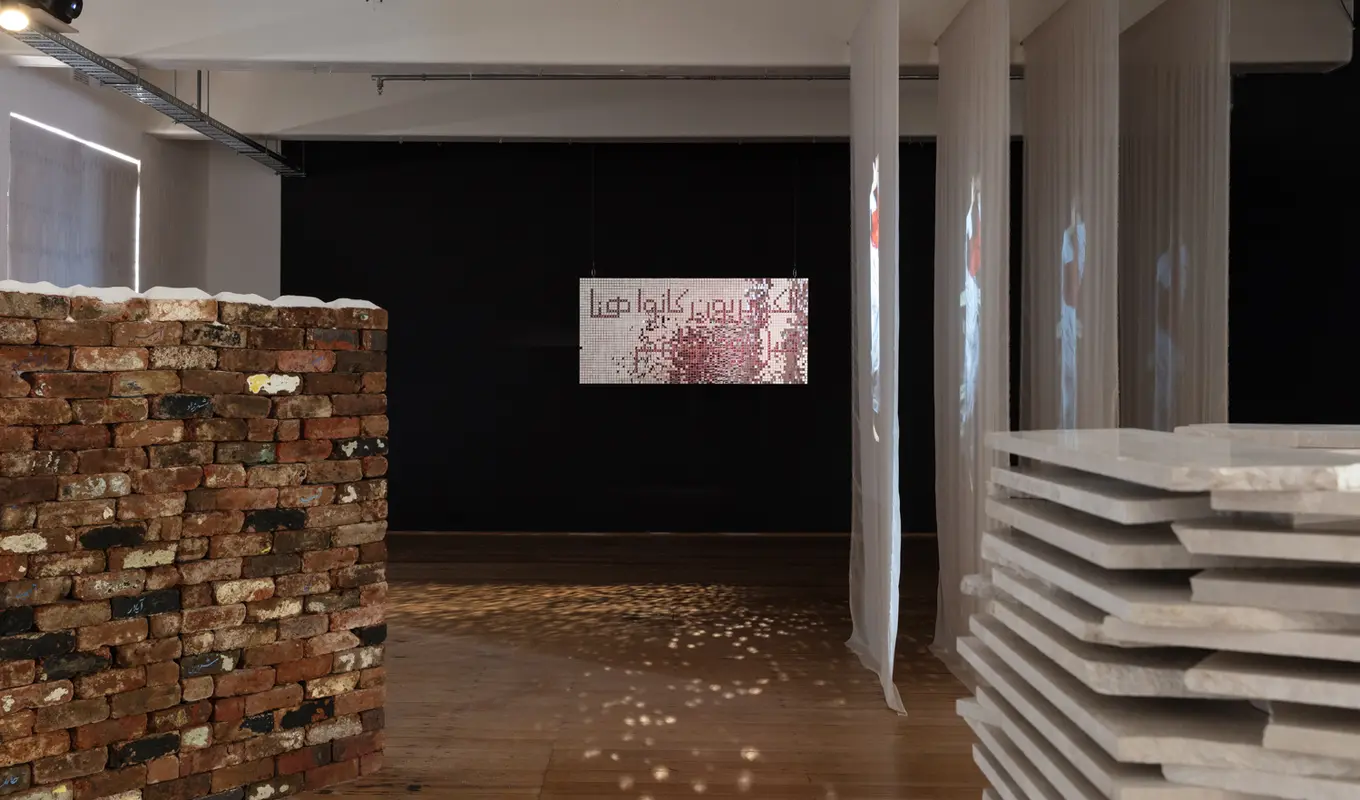
Later iterations of the project pushed upwards from the floor, stacking rock on rock to create a large hexagonal hollow form with hidden internal geometries within these rising walls. A re-making that reflected a desire to defy unmaking, by vertically pushing upwards from the original plane. Such a configuration concentrated much weight in one place, so heavy the floor of the gallery might not support it. The work expanded outward, in accommodation to the architecture. This vertical configuration created spaces within these new structures.
We discussed Sufism, queer secrecies and sacred geometries in relation to this space newly demarcated by rising walls as much as we discussed materiality and monumentality, Iran and Palestine, Israel and Australia. This new iteration spoke as much to me about exclusionary borders and fortresses as it did about cocoons and refugees within.
Zand relayed to me Farid ud-Din Attar’s Conference of the Birds. The Sufi text is a parable of the failed search for leadership. As the collective of birds flew over one valley after another with much hardship, their journey’s end was marked with the realisation that their own communal endeavour was without the need of a leader.
Zand’s decision to use marble was intentional; a decision to veer away from the colonial logics of extracting local materials on stolen land. Yet the off cuts he chose to use were of marble imported from Greece, Italy and elsewhere brought here to make luxury benchtops for kitchens and bathrooms. In a very literal sense, they are the vestiges of a process that enacts colonialisms through the act of making home. We discussed the vestigial status of these offcuts as a contrast to the figurative classical statuary and all the civilisational baggage they have come to acquire. In antiquity the Greeks colourfully painted their sculptures, but those muscles and veins were scrubbed back to pale stone bodies, sanitised for display in museums in the Enlightenment.
Zand’s components are relatively small, blank slabs of marble with neat – if unfinished – cut lines, one surface mechanically taken to a fine polish with the reverse ground flat and matte with precision. We discussed the handful of rough edges of these vestiges. He contemplated breaking the stones further, unmaking the components into a form useful for making; an anxious resolution in an increasingly frayed world, but one that ultimately sought to preserve the integrity of these cast off readymades and their industrial processing.
We discuss the taxing nature of moving the literal tonne of stone that forms the work. Later he complained about the toll of lifting and moving these heavy vestiges on his body. As much as Zand has agency in the making of his sculpture, it has a stubborn agency of its own: a queer dialectic of labour in which each shape and affect the other.
It is precisely these fraught contradictions of becoming this work that make it so compelling. It is a work that might attempt to defy a planar landscape of erasure by a reconfiguration that reaches upwards, but this gesture toward the heavens is far from triumphant instead building walls that variously exclude and contain.
Decisions around the materiality of the components may defy extractive logics locally, yet they import such extractions from elsewhere – the excess vestiges of things designed to make elsewheres here. A catharsis of undoing of these extractions might have followed from the experiments that broke the slabs, but attempts to eschew this colonial logic inescapably lead back to connections – wanted or unwanted – in a world where capital always ensures its own transit, if not that of the birds.
“I’m not going to sell sorrow” states Zand in relation to the configurations of queerness and our loosely shared geography of Western Asia, a sentiment I strongly share. And yet the current moment can speak of nothing but sorrow. Every aspect of developing this work has impacts from its literal weight on the stability of the institution to the vengeful material that breaks his back.
The re-formation of his work from a plane to a walled hollow shifts this sculpture from a God’s eye view to human line of sight, but it also situates our human vision on the very plane that was rejected as totalising. While the hollow within might be a space of refuge, it also atomises that which it contains: a defensive structure of hard stone that contradictorily both protects and repels. For all the inescapable connections that plague Zand’s pursuit of an ethical anti-monument at a time of such horror, it might only be Attar’s birds that can see the work in all its dimensions and potentials; refuse tentatively rising again.
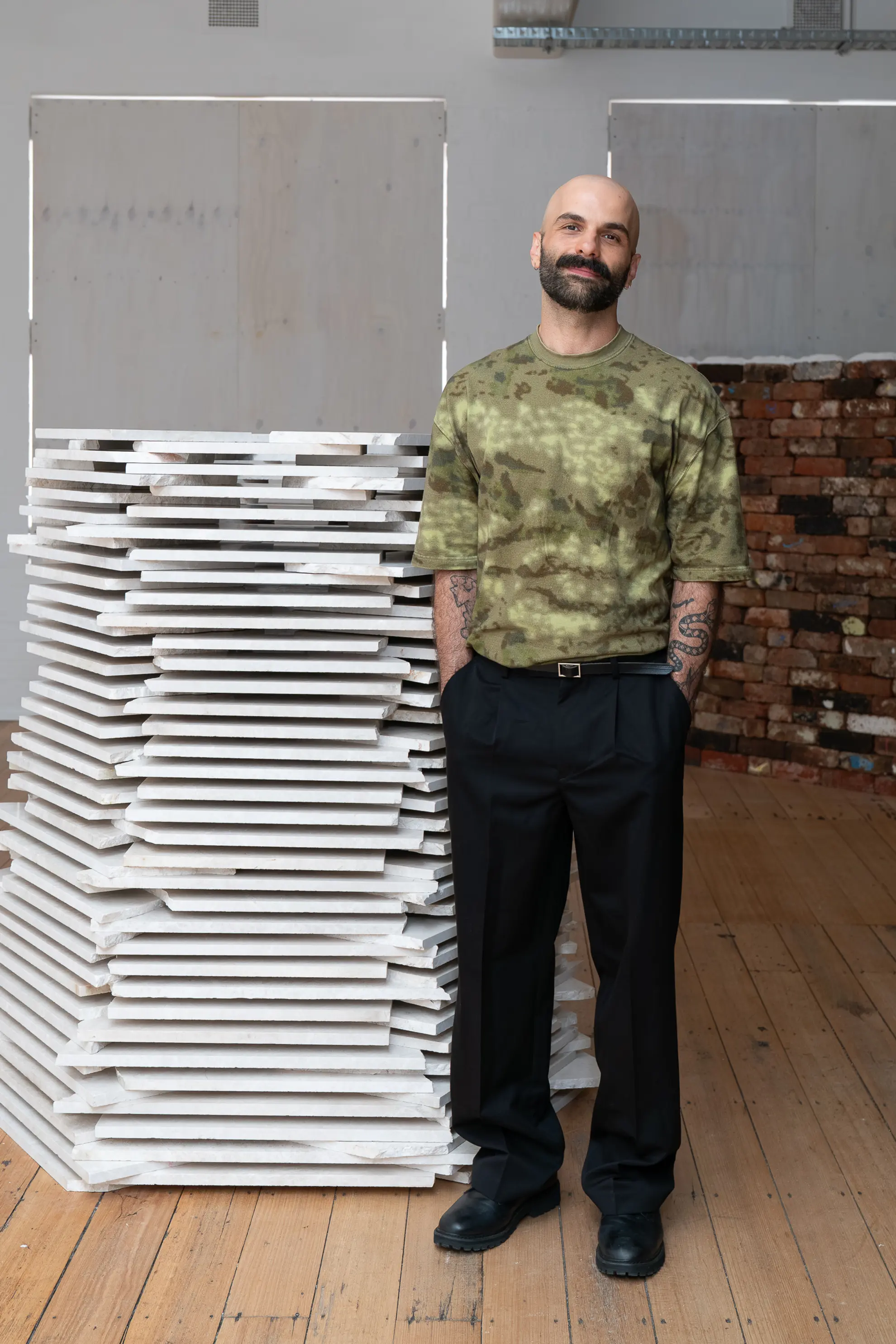
Sary Zananiri is an artist and cultural historian interested in the interaction between visual culture and processes of identity formation, particularly in the modern Arab World. By tracing the movement and circulation of people, objects and ideas, Zananiri’s work is concerned with cultural mediations from a transnational perspective. Recent exhibitions include the Qattan Foundation (2023), University of Groningen Library (2023), INALCO (June-July 2022), the Mawjoudin Queer Film Festival,Tunis (September 2022), the Australian Centre for Contemporary Art, Melbourne (December 2021-February 2022), the National Glass Museum, Wagga Wagga (July-November 2021), Rijksmuseum Oudheden, Leiden (May-October 2020) and Der Haus Der Kunst der Welt for ALMS, Berlin (June 2019). Zananiri has co-edited three books on photography and cultural diplomacy in British Mandate Palestine. Their forthcoming monograph, Photographing Biblical Modernity: Frank Scholten in British Mandate Palestine (IB Tauris 2026), looks at nationalist constructions of religion and masculinity in Palestine. Zananiri is a Senior Lecturer at Monash Art, Design and Architecture.