Patricia Reed
“Choral Stories and Interdependent Vocality (Thinking with Tina Stefanou’s Motet Fail)”
“The chorus is a vehicle for another kind of story, not of the great man or the tragic hero, but one in which all modalities play a part, where the headless group incites change, where mutual aid provides the resource for collective action, not leader and mass…”1
The need for another kind of story is distinct from the proliferation of diverse stories of the same kind. The crux of this calling from Saidiya Hartman’s work, is bound to the failure of historicizing enslaved, colonised and othered lives by way of imperially-infused archives that are structured by the very absence of these lives. Rather than seeking recovery of such erasure following the historiographic script, Hartman departs from this failure as a catalyst to rethink practices of historical imagination that can narrate the past without repeating its foundational conditions of violence – a method she terms ‘critical fabulation’.2 This method strains against “the limits of the archive” while making the “production of disposable lives” visible at the non-sites of archival absence where the workings of power and authorized memory can be witnessed.3 Beyond ‘giving voice’ to those denied recognition, Hartman’s reinvention of historical method shifts from the primacy of individual protagonists and particular events that obscure the experiences of the many, gesturing rather to shared conditions of resistance, joy, refusal, and care in the rejection of an assigned fungible status from the taxonomic purview of an imperial archive.
Oscillating between first and third person, intimacy and extimacy, these other kinds of stories are enabled through the polyphony of the chorus, that while precarious, is irreducible to the monotone status of ‘singular being’ trapped in an epistemic designation of victimhood alone.4 It is through this prism of what failure discloses and the different kinds of stories it compels, that the chorus emerges as both narrative vehicle, collective figure, and experimental process of performative assembly.
Tina Stefanou’s Motet Fail resonates within such counter-narrative fields opened by this understanding of failure that is never a mere mistake, nor error, but always a relation to the power imparted to sanctioned mastery across disciplinary and aesthetic contexts.
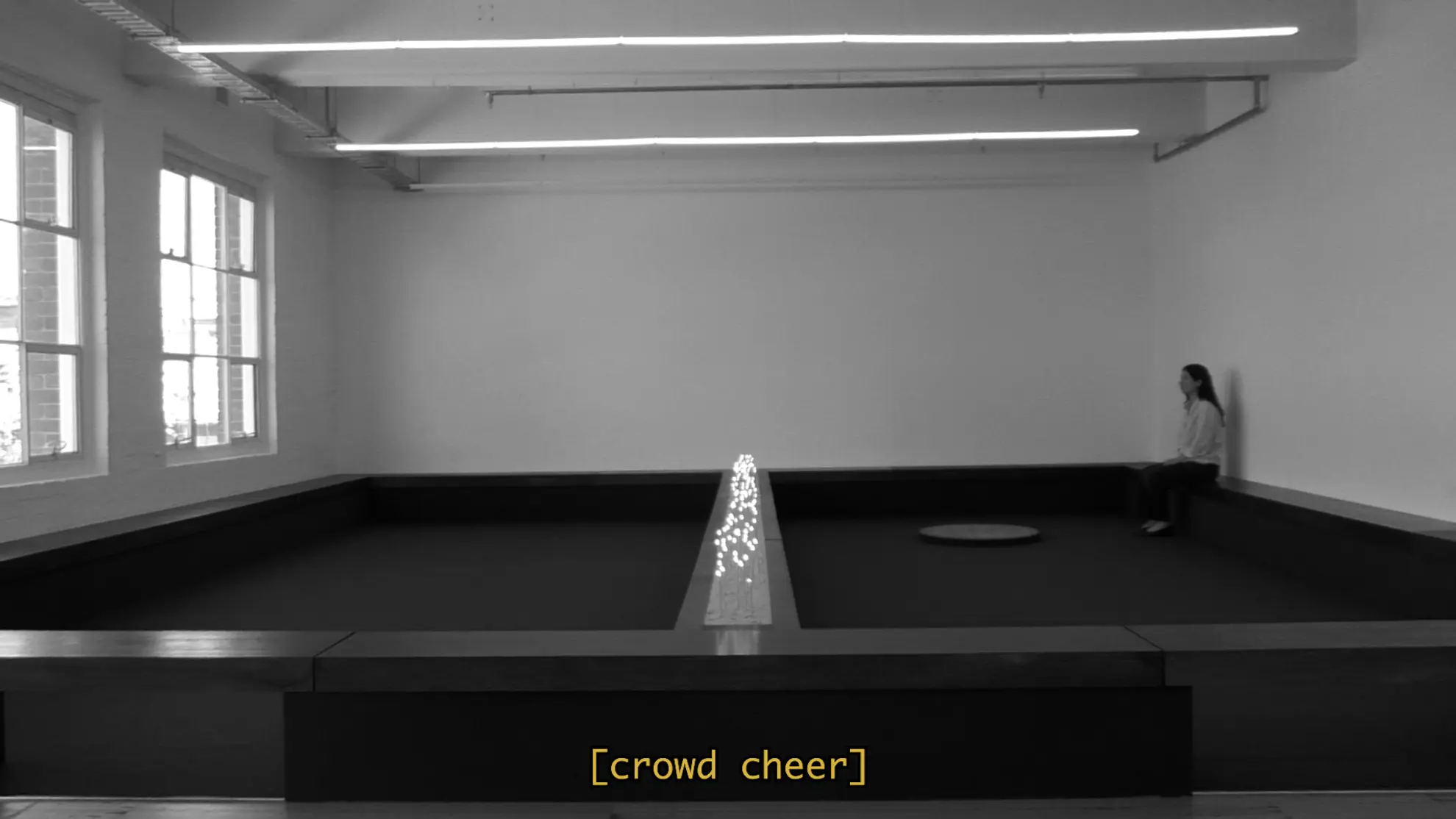
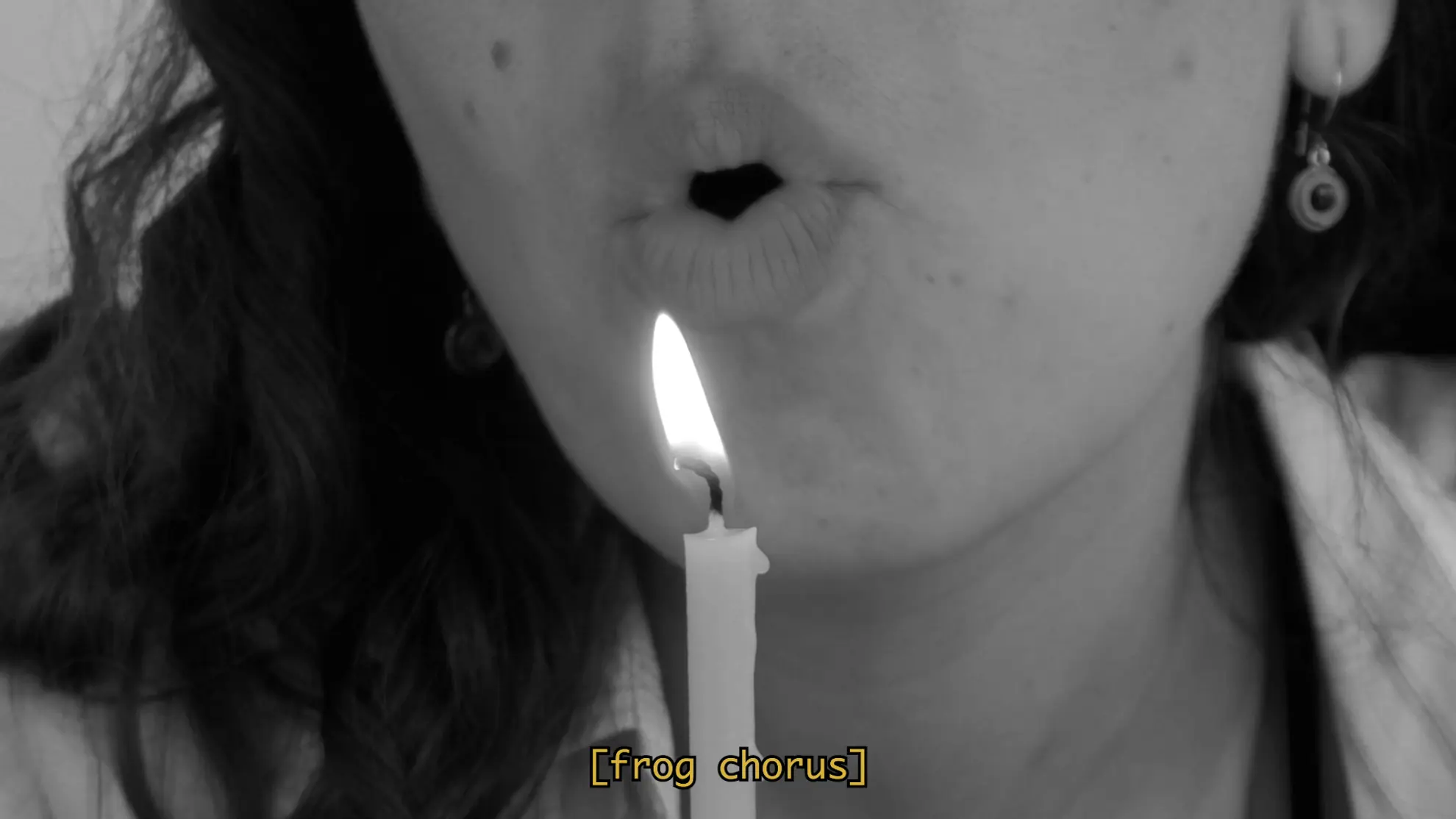
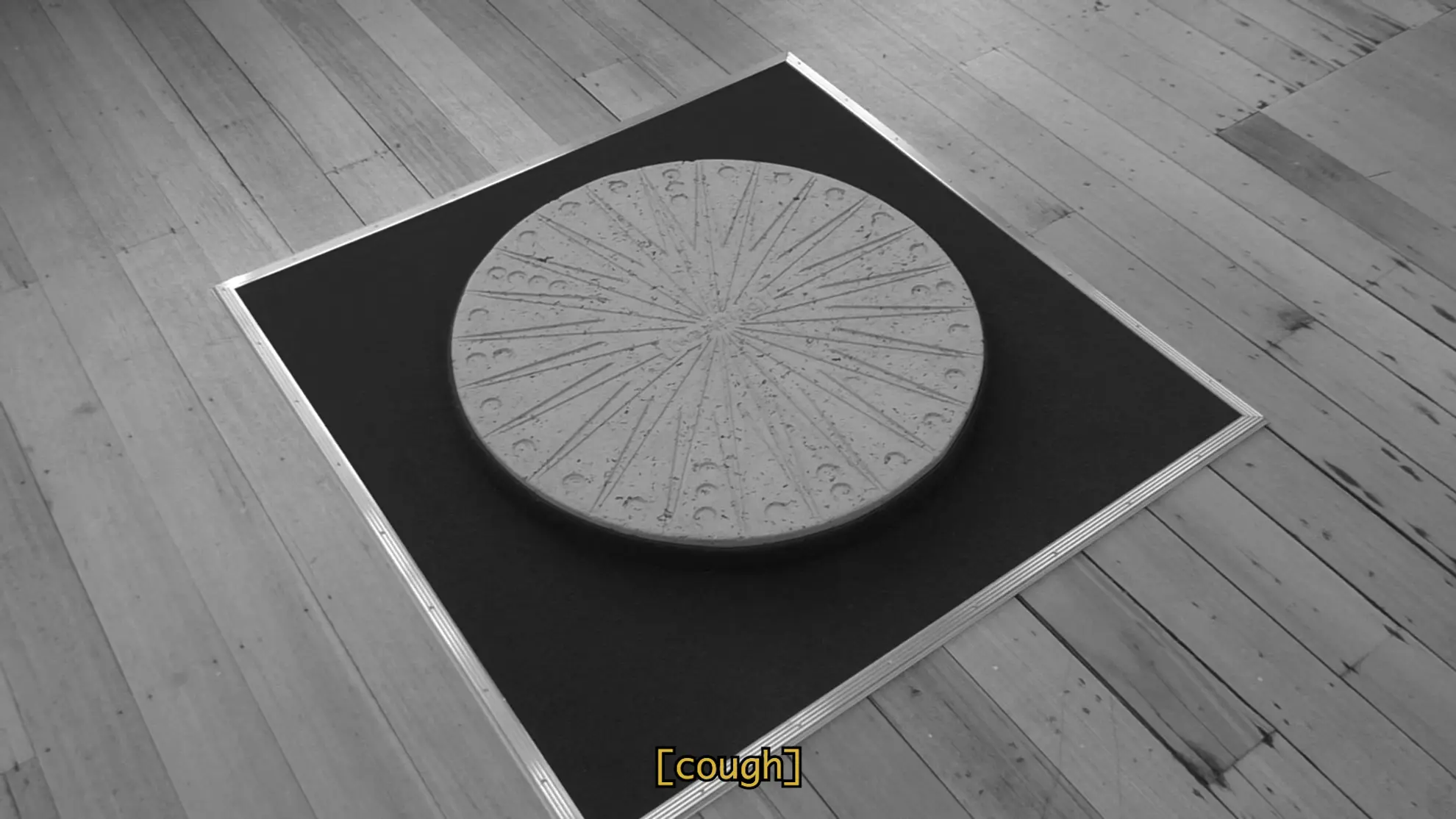
In hybrid dramaturgical and exhibition form, Motet Fail stages recurrent, performative choral clusters toying with unusual harmonics within a room-sized, abstracted backgammon board delineated by a carpet and bounded by benches engraved with surreal closed captioning, not bland transcription. Sounds circulate and spatialise as auditory material, with the subtle pressure of exhaled air and currents produced by bodily movements revealing an ambient energy animated by flickering candles, demonstrating an atmospheric butterfly-effect through an archaic sensor: fire. Audiences are quietly received by gallery workers who poetically recognise their presence through the lighting of candles while tending to the fleeting maintenance of their molten impermanence.
As an intermedial work, Motet Fail sets up an immersive theatrical encounter where enfleshed choral vocality actuates an evolving rehearsal at the intersection of collective labour and chance hang-out, spontaneous congregation and rule-based play. Just as the pursuit of mathematical perfection in backgammon cannot escape a toss of the dice, this structure between rule and contingency is allegorically transposed to performative acts centring voice itself, challenging the conditioning of agency described solely in singular and virtuosic registers.
Virtuosic vibrato may be measurable against a flame that gently wobbles without extinguishing as evidence of controlled breath, yet never replaces the expressive meaning of a voice that fails and involuntarily cracks in protest of over-exertion.
Stefanou’s practice within an expanded field of voice coincides with empirical and ethical scrutiny of several metaphysical foundations from the Western tradition, particularly ones wherein the voice played a defining role. Notably, Aristotle’s splitting of the voice between phōnē (the sonic, or expressive sound indicating pleasure, pain, hunger, etc.) and logos (the semantic, or complex communicative language); the latter used to justify anthropocentric world-views where exceptionalism has become a lubricant for supremacy over the ‘merely sonic’ animal world.
The cascading consequences of this vocal split that mentally cleaves humans from animals, figure from ground, culture from nature, contributes to a “metabolic shift” in productive activity following an extractive screenplay.5 Climate crisis, after all, is a scalar amplification of this productive metabolic shift, accelerating since economic industrialisation and the transformation of labour therein.
Sonic and semantic divisions in voice have permeated inter-human domains as well, introducing a similar hierarchical schism within humanity itself, between ‘civilised man’ who possess discernible speech and ‘barbarian subhuman’ who makes ‘incomprehensible’ sounds. From the root barbaros, indicating the onomatopoetic sound of babbling to Ancient Greek ears, the inferior status conferred to a barbarian enunciator turns out to be a marker of ignorance afflicting civilised man who conflates his linguistically decipherable world to that of universal code. As we wrestle today with cumulative material and psychosocial histories that never remain in the past, Stefanou’s staging of choral polyvocality draws us into an acoustic space that unsettles the rigid and ideologically consequential sound/semantic split.
Voices in Motet Fail are diverted from their foundational history premised upon an exceptional rift, towards another kind of story where they practice forms of assembly through a spectra of phonations as an organon for sensing interdependence.
‘Interdependence’ is not a benign notion, but rather yokes metabolic necessity with the indeterminate messiness of social, political and aesthetic negotiation. Like the undoing of a sonic/semantic split, thinking vocality in terms of interdependence invalidates a separation between the material and the symbolic: from the biophysical vibration of flesh and resonate substrates that perpetuate sonic frequencies regardless of semantic content, to the voice as a carrier of self-representation, including its possibility of withholding as a form of silent agency.
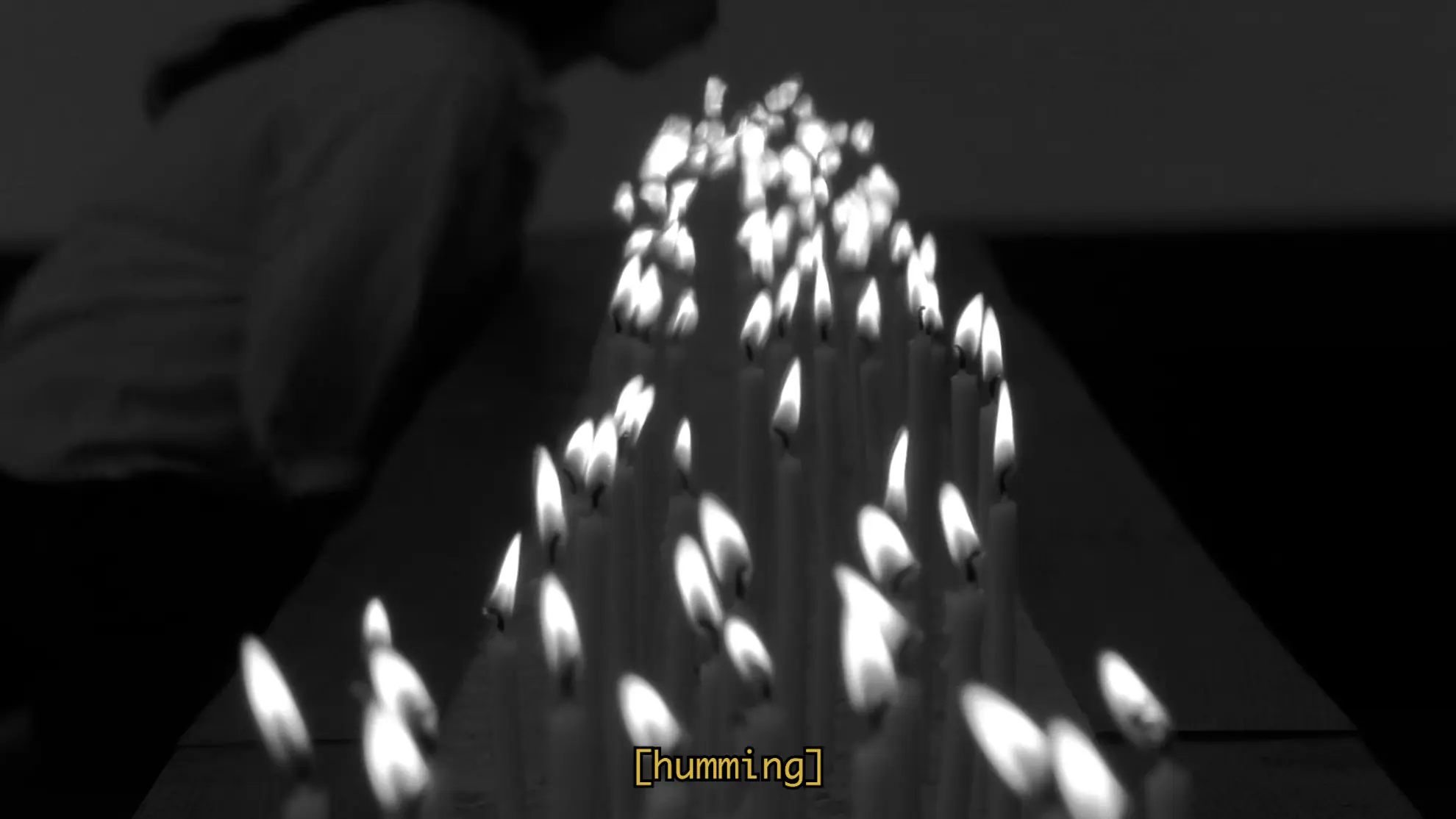
The choral, flocking architecture of Motet Fail introduces what could be described as a harmonic friction: a performative discovery of somatic association that does not romanticise interdependence as purely smooth or pleasant-sounding vocal interactions. It is a social ecology that is chorally animated and, as a relational body, it is entwined with processes and legacies of mediation impacting “our perception of ourselves and each other,”6 as well as “heardness” writ large.7
Coined by Lee Gilboa, ‘heardness’ addresses the failure in transcribing the semantic thickness of oral testimony in the legal context when reduced to a language-only understanding of meaning. Heardness responds to the insufficiency of words to account for vocal performance, and rather than listening to a voice Gilboa posits heardness as listening for a voice: an approach to listening grasped as an “analytic tool”.8 Through heardness, choral vocality is not only an array of bodies that emit sounds in space and time, but an assembly of analytic listeners who co-organise the terms of their spatial and temporal relationality. Harmonic frictions are the result of a voice (that individuates) sonifying its social negotiation among a choral vocality (that multiples) in an activity that defies mastery and certainty because a relational form cannot be predictively determined, nor individually controlled.
Improvisation in Motet Fail isn’t performed with an ethos of negative freedom from structures of coherence, like how it is often portrayed as a spontaneous “capacity to create ex nihilo,” as artist and theorist Mattin puts it, but a positive freedom to understand its conditions of social mediation “while generating its own rules” in co-constructing its terms of assembly.9 Each vocal utterance is a roll of the dice to be chorally heard in this acoustic game-space, each phonation an implicit proposal of how to relate in co-composition, leading to an atmosphere populated by the aural testimony of its conditions of relation emanating from a polyvocal body.
The choral counter-narrative enacted by Motet Fail implicitly troubles the measure of mastery, not in steadfast proclamation, nor in the denial of vocal proficiency, but rather in the troubling of how said measure, as an artefact of normative power, orchestrates conditions of aspiration. Resonant with Foucault’s partial negation of not being “governed like that,” as an imperfect collective aurally performs the improvised terms of its game-like forms of congregation, another kind of story emerges with wholly other metrics of virtuosic recognition.10 Beyond purely linguistic semantics, when the choral body mediates its testimony of communicative assembly, the conditions of vocal virtuosity are expanded from that which individuates, to that which transindividuates, imparting meaning to vocality in socially negotiable terms.
Patricia Reed is a theorist, artist, and designer living in Berlin. Her work addresses social transformations of coexistence at planetary dimensions, focusing on the interactions between world-models and practices of inhabitation. She is Head of the Critical Inquiry Lab (MA) at Design Academy Eindhoven, and a lecturer at Folkwang University. Recent essays have appeared in Informatics of Domination (2025), Pierre Huyghe: Liminal (2024), Navigation beyond Vision (2023), and Ceremony: Burial of an Undead World (2022).