Tahmina Maskinyar
“I live of Hope”
These were the words that led me to the home of Mags Webster. I had brought a failed baking experiment; a gluten free cake that most definitely needed another 30 minutes in the oven, despite my sum three hours of effort with putting it together. Mags took the cake with gusto and emphasised that we could eat around the soggy middle. She gently and compassionately guided me and two other friends through three writing exercises. We sat around her small dining table in her sunlit kitchen, my soggy cake on everyone’s plates, as we shared the raw words we had scribbled in our notebooks with each other. It is a core memory, the first time someone had truly paid attention to the in-between and unrealised spaces within my nascent free-verse passages of prose.
It was also the first time I had visited the home of a writer, and I was enthralled, books outnumbered everything, they were stacked in winding compositions in every single room, teetering, all at different heights. Bookshelves overflowing, books open at the spine and splayed face down like garden moths resting after being trapped in a disorienting loop from a light source.
It was a wonderland.
Mags had dedicated her spirit to an attention to words. Relished in sharing stories, intonations and structures, relaying her curiosities with such tenderness, everybody could feel welcomed and motivated to attune themselves in the same way. She was a true teacher, able to inspire and part away the layers of fear that so often suffocate one’s personal expression due to expectations of specified grammar and logics.
She was an antidote, someone who built the quality of my writing and the confidence of my personal expression at a time when I was rebuilding a self to call my own. How lucky am I to have known her and to have shared in friendship and moments of joy.
Mags completed a PhD in literature in 2020, a beautifully crafted thesis that embodied her nature across its sum 80,000 words. Within her thesis she attempted to describe the indefinable qualities to written language, with a focus on the faculty that feeds poetry when it employs apophasis, a word deriving from Greek meaning “denial” or “refusal”. For Mags apophasis opened many roads that led to understanding, chartering capacity for the language maker to relay something that is unsayable.
“I suspect that in the gaps between said and unsaid, written and unwritten, there might be the most beautiful and ineffable language yet? Language that (for now) is tantalisingly beyond my reach, and may always be? Is it my level of competence with language that limits utterance? Or is it my desire to speak lyrically of things language cannot adequately convey? To write lyrically of things language cannot adequately convey.”
— Mags Webster1
It is within the memories I hold of Mags, and the manner in which she cared for language that I dedicate this humble offering of an exhibition frame that has been so luminously responded to by Moorina Bonini, Nithya Iyer and Chi Tran.
To make an exhibition about language is to almost predetermine a failure in meeting expectations, and yet I attempted it anyway. As Julian Casablancas wrote you only live once and as the angel Aaliyah once said, if first you don’t succeed, get yourself up and try again.
language to reach with is intended as a propositional exhibition, or perhaps an exhibition about references, or perhaps an exhibition about the holographical craft of art making, or perhaps about the pluriverse of expressions that we need to nourish rather than shrink away from. It certainly was in response to the banality and dystopic nature of Large Language Models. In the fear that even though language has always been diachronic, in that it changes and evolves over time, the pace of LLM consumption will no doubt have a devastating effect to a world already contending with cultural homogenisations. As Tamil-American Anthropologist Arjun Appadurai notes “electronic (digital) mediation, mass migration and the driving forces of globalisation have the dramatic joint effect on the work of imagination.”2
An estimated 12.5% of the world’s population engages with ChatGPT on a regular (almost daily) basis.3 To be locked in, en masse, in this way, as knowledge and language is created for us rather than by us, do we not lose our capacity to imagine? Imagination, one of the most critical human foundations and a necessary ingredient for societal change and growth. Imagination—which is arguably a basic human right, at its purest form—free from capitalist systems.
“In trying to surmount the difficulty of finding words for the inexpressible, I can either choose to fall silent, or find ever more inventive and oblique strategies to land on a description or image."
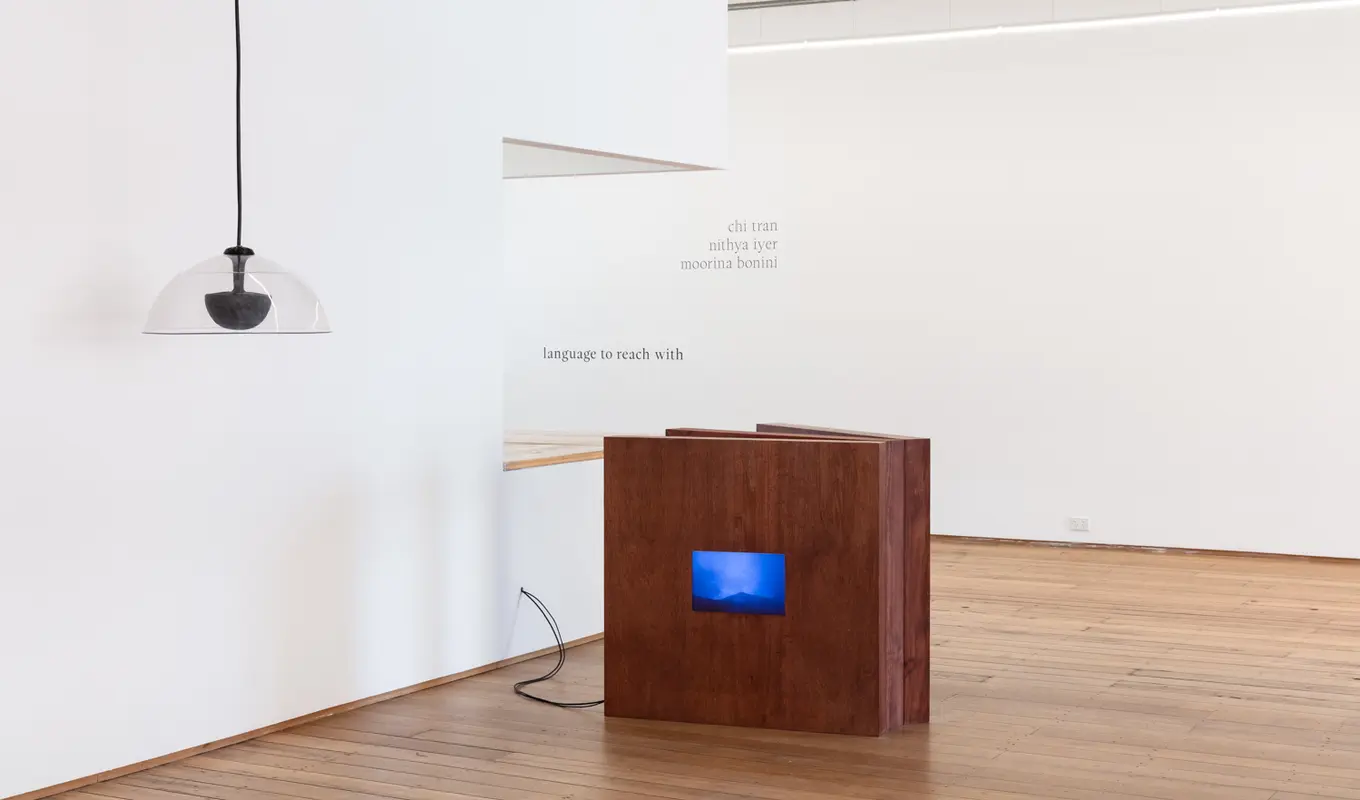
Within the West Space gallery language is offered in its extended form. Sonically, through the presence of Yorta Yorta Country, within chorographical and choreographic compositions, film and spoken verses. Whilst this does not capture the full breadth of language, it is demonstrative of the tools for expression we have at our disposal, in place of a reliance on LLMs.
Moorina, Chi and Nithya each hold a distinct sensibility to language, informed by their personal and familial histories and connection to ancestral culture. In this I recall the words of Brian Martin who emphasises art making that is not informed by Western logics; “art (that) is vital to the formation of cultural identity as cultures rely on practices that articulate memories, which are embedded within a collective consciousness.”4 So, in each work exists a reaching towards (by the artist) and an invitation towards (for us as the visitor) to attention, in an attempt at meaning making.
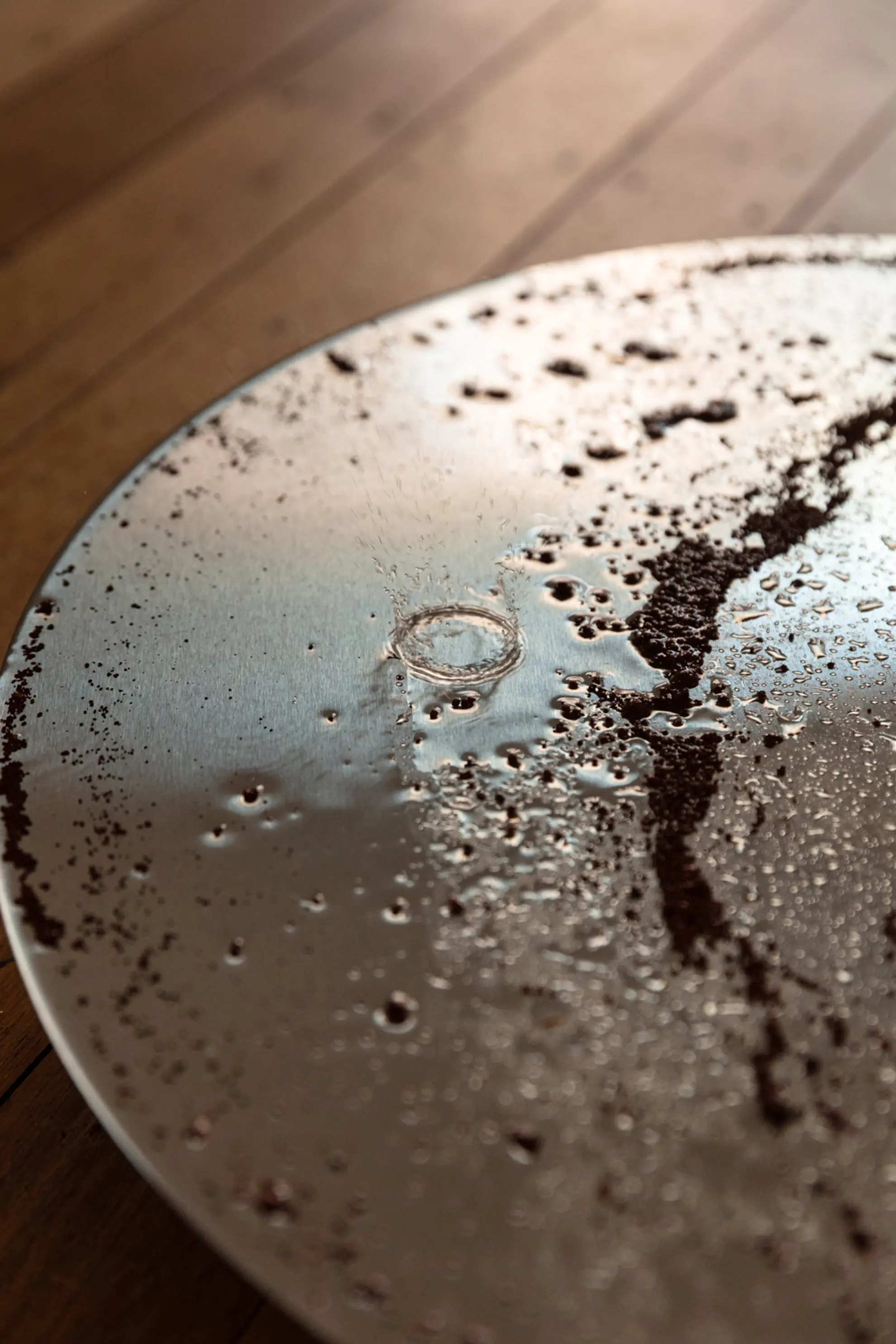
The language of Woka by Moorina Bonini is a metaphysical sonic field. I read it as a sovereign but enveloping threshold, oscillating in pace, strength and frequency, between stillness and aliveness, a groundswell of communication for our perception. The vibrations of Yorta Yorta Country meet with the resonance and material memory of ochre, which is in turn, enlivened by water—binding sound and mark making together. The sonic field of The language of Woka permeates through the porous windows of the West Space gallery and descends into the precinct. Here the work incorporates audiation—the reverberations of Woka eventually transfer to dormant energy as sound waves move further away from their source.
In the conversations I was able to have with Moorina as she was developing the work, we spoke to the possibility of this edition becoming a testing ground for a continued enquiry by Moorina into the ways Country can have an overtly foregrounded presence in her work. The language of Woka signals a shift in Moorina’s practice, where seemingly modest enactments by the artist yield liberty back to Country to express freely, separate from pre-mediated calibration.
Martin explains that Indigenous culture has its ideology grounded both materially and metaphysically in "country" itself, this being inextricable to Indigenous art making and ever present in every single one of Moorina’s artworks. The work reflects the deep and embodied connection to Country Moorina holds, while also being an invitation to non-Indigenous folks to consider the metaphysical, that which is ineffable, as an opportunity to register to the frequency of Woka (Country), and perhaps understand it a bit better.
Held between Moorina’s sonic field are Musa genus a triptych of photographic pictograms by Nithya Iyer and Unable to rest because unable to know, a mixed-media installation by Chi Tran. Each work incorporates a distinct use of apophasis to generate discovery of meaning. Its use employed through diverse linguistic modalities such as image, scale, metaphor, rhetoric, gesture, non-human auditory communication and theology.
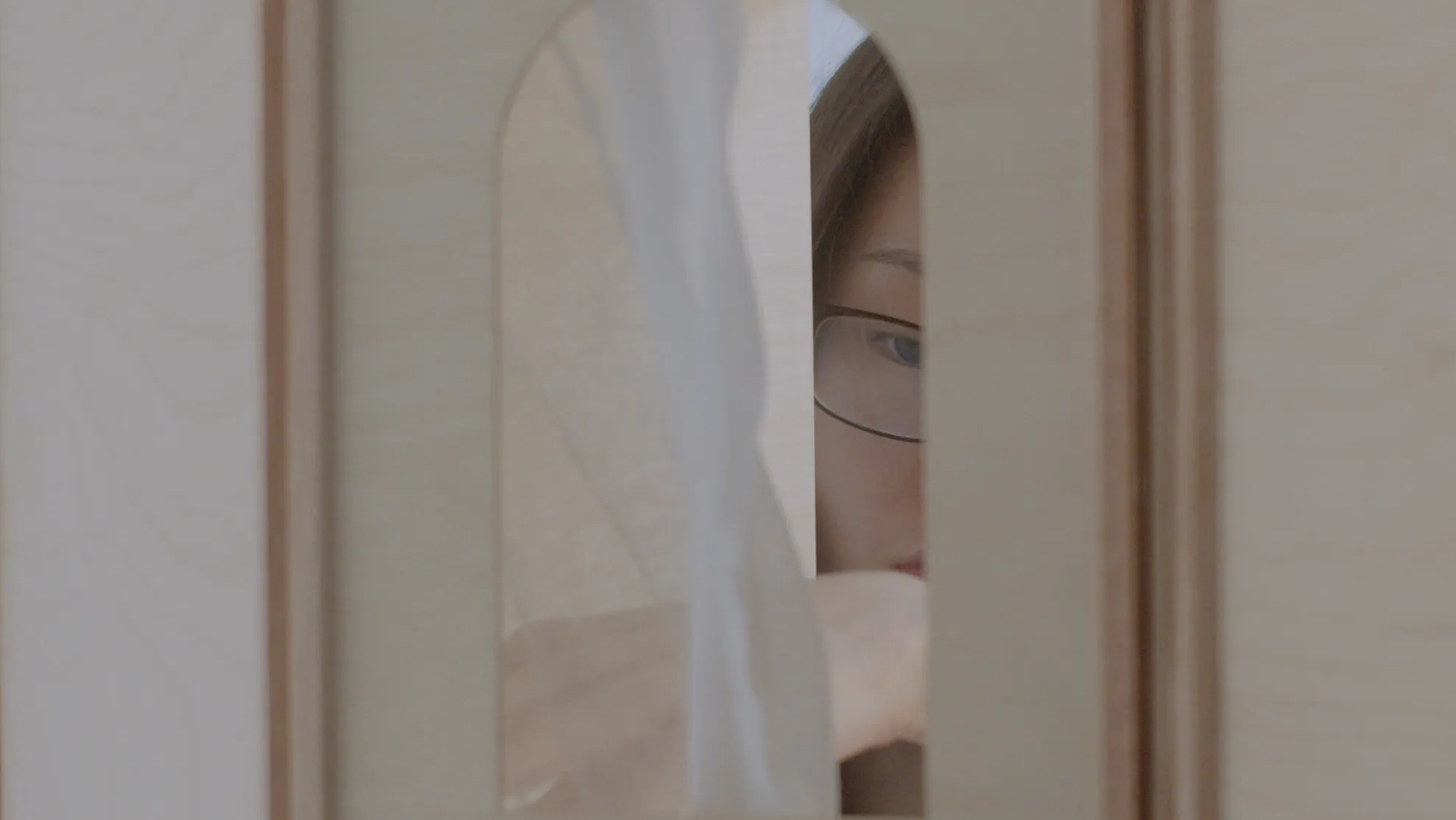
Audiences first encounter the back of Unable to rest because unable to know, presenting itself as an abstracted echoing frame. The work encourages one’s physical presence to make an effort to discover. Moving around the work you are met with a small, illuminated image, a life-size figure peering through another structure. The work interplays with scale and our gaze. You are at one point the same scale as the figure in the illuminated box, at other times, you are viewing her as if from a distance. You are also viewing the distance at a scale that could render the heft of mountains and the skirt of their rolling clouds obsolete.
I consider Chi’s practice like the strata of a mountain, layers upon layers, records of deep time, something that can never be experienced in completeness. You’re grateful to begin the uphill hike, and as you consider the micro and the macro, you are gifted comprehensions and come to appreciate the abundance of the garden of meanings ahead of you.
The work engages with glitch as a rupture to be contended with, and as a passage for potential learning or retrying. Here I refer to Legacy Russells’ critical text Glitch Feminism where she acknowledges the conditioning and predisposition of discomfort and outright fear in experiencing errors and malfunctions. For Russell, Glitch Feminism “embraces the causality of “error” and turns the gloomy implication of glitch on its head by acknowledging that an error in a social system that is already disturbed by economic, racial, social, sexual, and cultural stratification of the imperialist wrecking-ball of globalisation may not, in fact, be an error at all. But rather a much-needed erratum."5Unable to rest because unable to know speaks to this desire. It is backlit with hope, in trying, in recovery, and in quiet reflection.
"What happens to our imagination and creativity if everything must be demystified or defined, or if we do not allow ourselves to linger over what cannot finally be explained away?"6
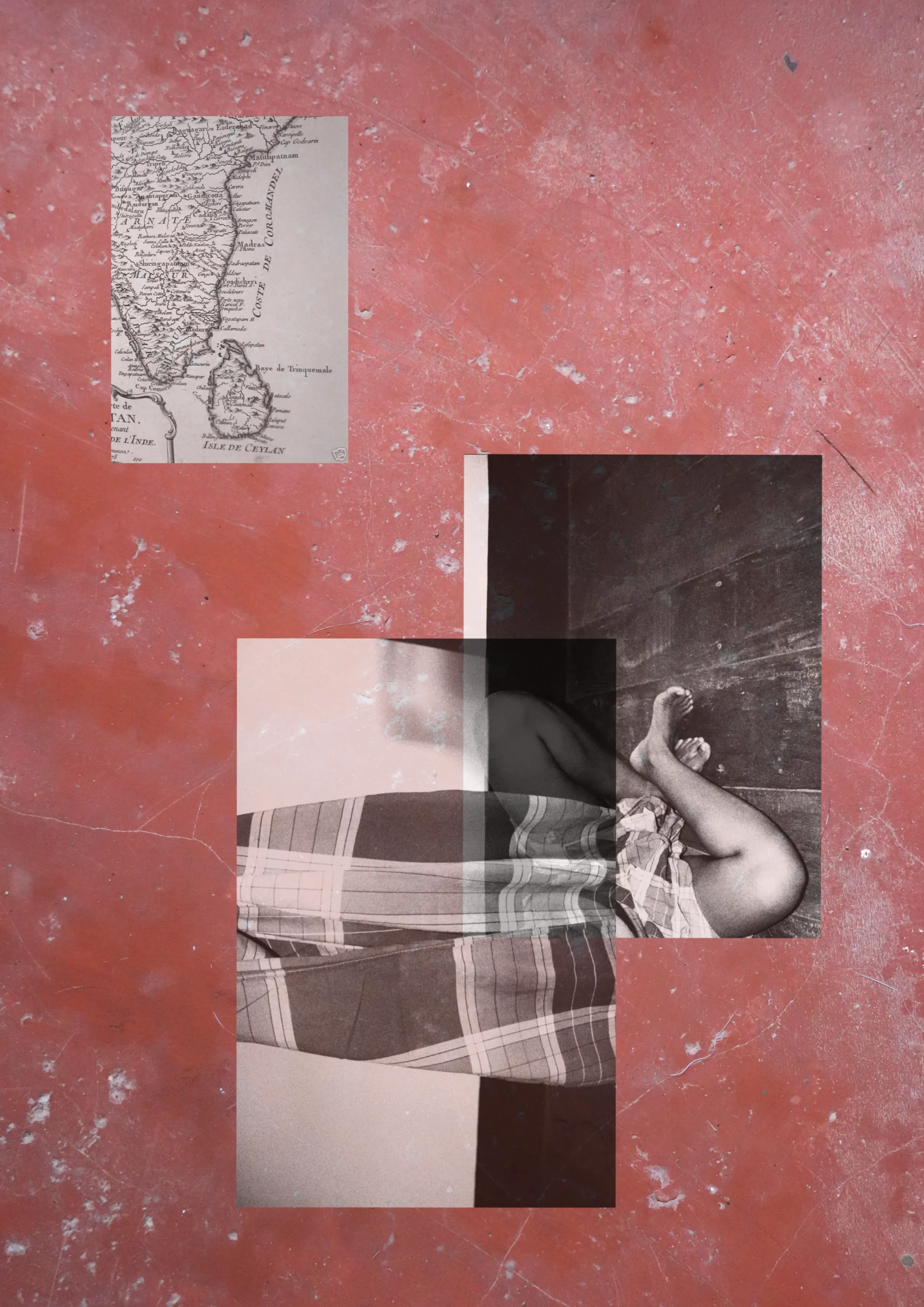
Nithya Iyer’s Musa genus dances across multiple coded gestures, upturning our perception, and gaze to render an awareness of the depth of entanglements and polyphony of evolutions connected to a singular identity or lineage. Nithya is a classically trained Bharatanatyam and Odissi dancer, a foundation that enriches the compositions of her visual arts practice and critical enquiry.
Musa genus becomes a type of visual autotheory, that is the practice of blending self-representation with philosophical and theoretical engagements. A methodology of expression that enables Nithya to contend with the many inheritances, expectations and erasures that inform a life and the context it exists in.
The work is also a chorography, mapping and describing the Tamil Nadu region through the metamorphosis of body meeting organic matter and the various tropes that have come to define or homogenise what was once a much more pluriversal region. Musa genus is perhaps frustratingly opaque, and for me that is its strength, a reclaiming that Nithya affords herself, in her own right and within her critical understanding of her heritage.
I will end with another beginning—the title of the exhibition—language to reach with, which references Whereas (2017) a book of poetry by Oglala Lakota poet Layli Long Soldier. In this book, Long Soldier instates language’s deep participation in life building, an active force that is strengthened by our attention to it. In the prologue of Whereas, Long Soldier says "...each People has been given their own language to reach with, I understand reaching as active, a motion."
May we reclaim our language sovereignties and revel in the various ways we are able to express ourselves.
Tahmina Maskinyar is a curator, researcher and writer, born in Kabul and raised near the Djarlgarro Beelier (Canning River) on Whadjuk Noongar Boodja in Australia. Tahmina’s professional experience spans academia, not-for-profits, volunteer boards, and government. She is currently the Curator at West Space. In 2024 she produced the Golden Lion winning exhibition kith and kin by artist Archie Moore and curator Ellie Buttrose for the 60th Venice Biennale. Tahmina’s writing has been published nationally. Her doctoral research at Monash University examines the imperial formations that have produced the geopolitical space of Afghanistan and the ways contemporary art practices register, mediate, or contest those conditions.