Talia Smith
“Spilt Milk (and hard honey)”
‘The land of milk and honey’, originally a biblical phrase, was used in the 1960’s and 70’s to describe Aotearoa and Australia as lands of abundance for Pasifika people who migrated from their homelands. So-called better work, education and economic opportunities were promised and what started as something positive ended with discrimination and scapegoating placed on those that had migrated. This racist history and its ripples influenced a generation of Moana peoples, first and second born family members feeling the heavy weight of sacrifices and the growing geographical and emotional distance between here and there.
I am a second generation Aotearoa born Moana person of Cook Islands, Samoan and Pakeha heritage. My grandmother migrated from Aitutaki and my grandfather, Samoa. They met in Aotearoa and had seven children, settling first in Ponsonby in the central suburbs of Tamaki Makaurau (Auckland) and then eventually, after gentrification forced Moana peoples out, in the west Auckland suburb of Avondale where our family home still stands.
For much of my life I struggled with understanding my place in the context of my family and the greater Moana diasporic experience. As is typical of most Western education, Moana art theory and artists were not a large part of my experience but despite this, and perhaps even because of it, this did not stop Moana artists continuing to make, exhibit and write about their works.
Much like the trappings of the promises of milk and honey, the colonial structures of the art world also began to dictate how one could experience their culture and how to represent it. Multifaceted and nuanced Moana practices were packaged into palatable or simplified themes for largely white audiences, no fault of the artists themselves who were making work that would influence mine and future generations of artists but rather the institutions who wanted to create neat and tidy labels to understand something other than works from Europe.
To situate contemporary Moana practice it is important to always acknowledge what has come before, and particularly for this exhibition, to then explore how early career artists are building upon these worlds and legacies. Academic and writer Lana Lopesi states that Moana artists now are looking to create “A place to stand in their own creative sovereignty based on their own practice, rather than being swept up into perceived aesthetics and convenient concepts.”1 Perhaps this is what our ancestors wanted when they started their lives in new countries, for the future generations to remain true to themselves no matter what shape that may take.
For the group exhibition Spilt Milk (and hard honey), seven early career Moana heritage artists from Aotearoa and Australia share their practices that vary in medium and ideas. What is exciting for me about each practice is the way in which they are asserting their ‘creative sovereignty’ outside societal or art canon expectations. There is a confidence in their making I admire, it is a kind that I can still struggle with when I am making my own work and it brings me joy to see that this next link of the legacy of Moana art is not so afraid to voice their truth.
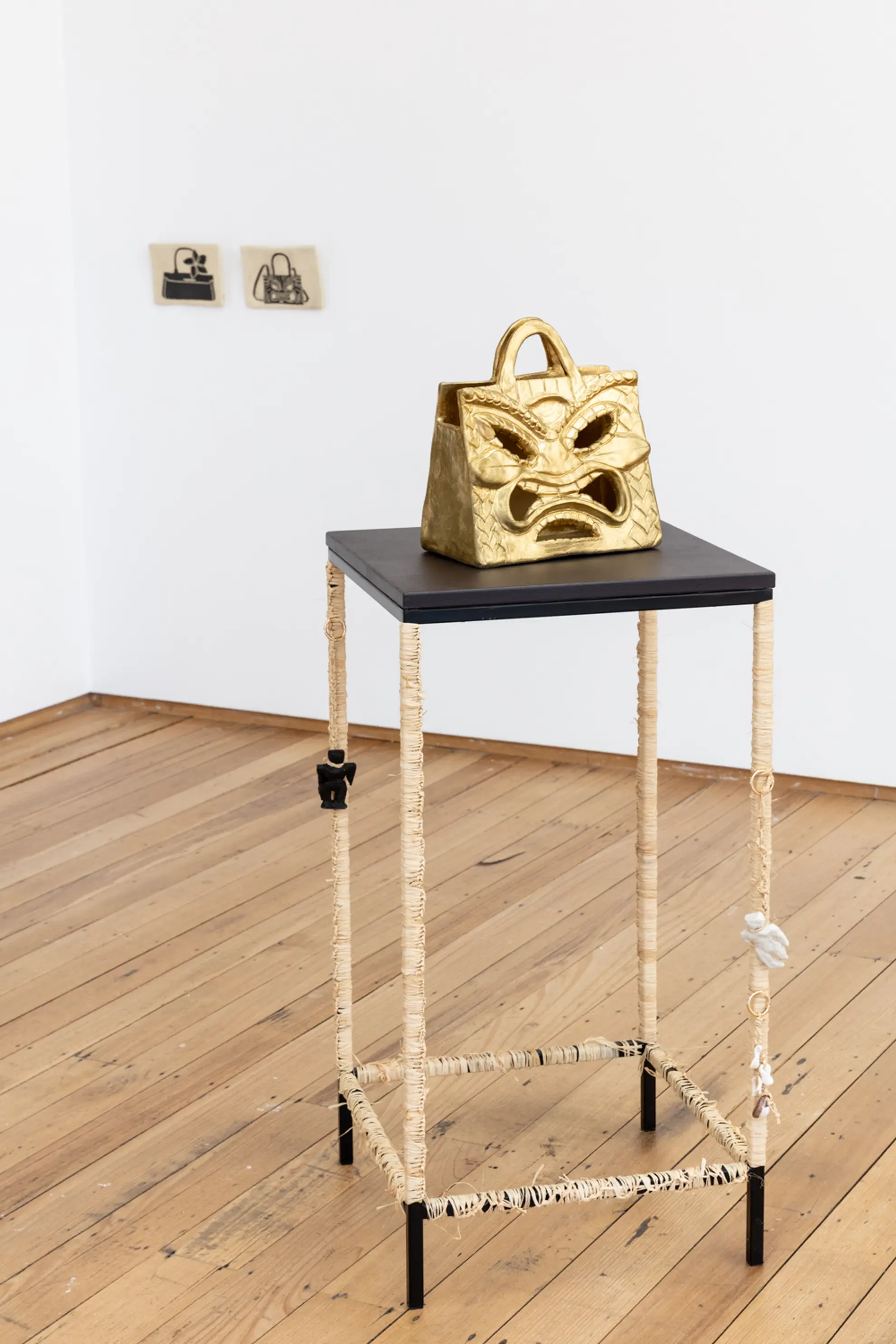
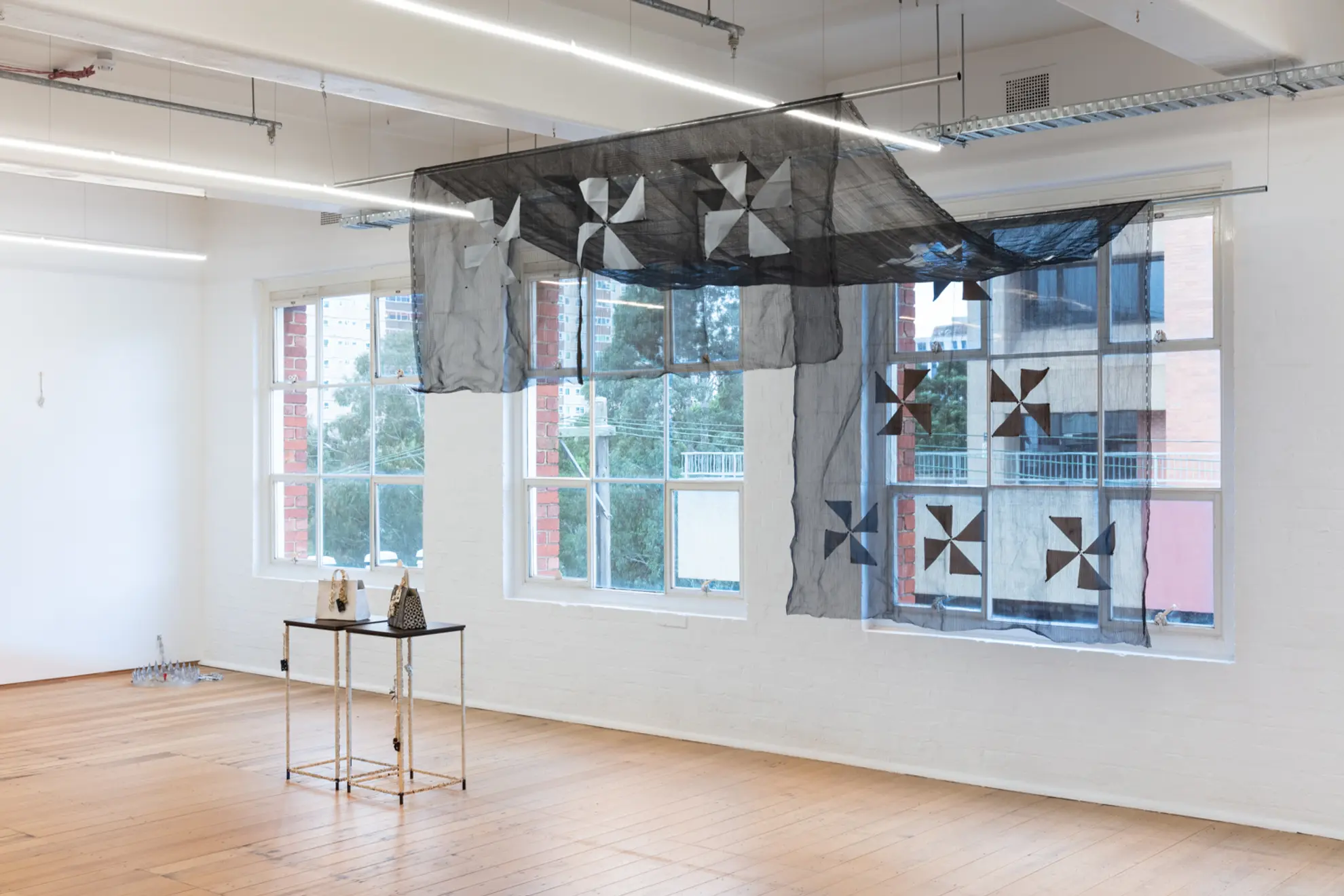
Situated around the gallery are Benjamin Akuila’s works, titled Katalogue, which turn a mass produced and well loved tourist object, the kato, into porcelain objects adorned with raffia, gold and shells. Solid in structure but delicate in material, the kato are elevated, commenting both on the adaptability of Tongan art practices but also a consideration of what kato could become to reclaim its sovereignty as a cultural object and less as a commodified tourist keepsake.
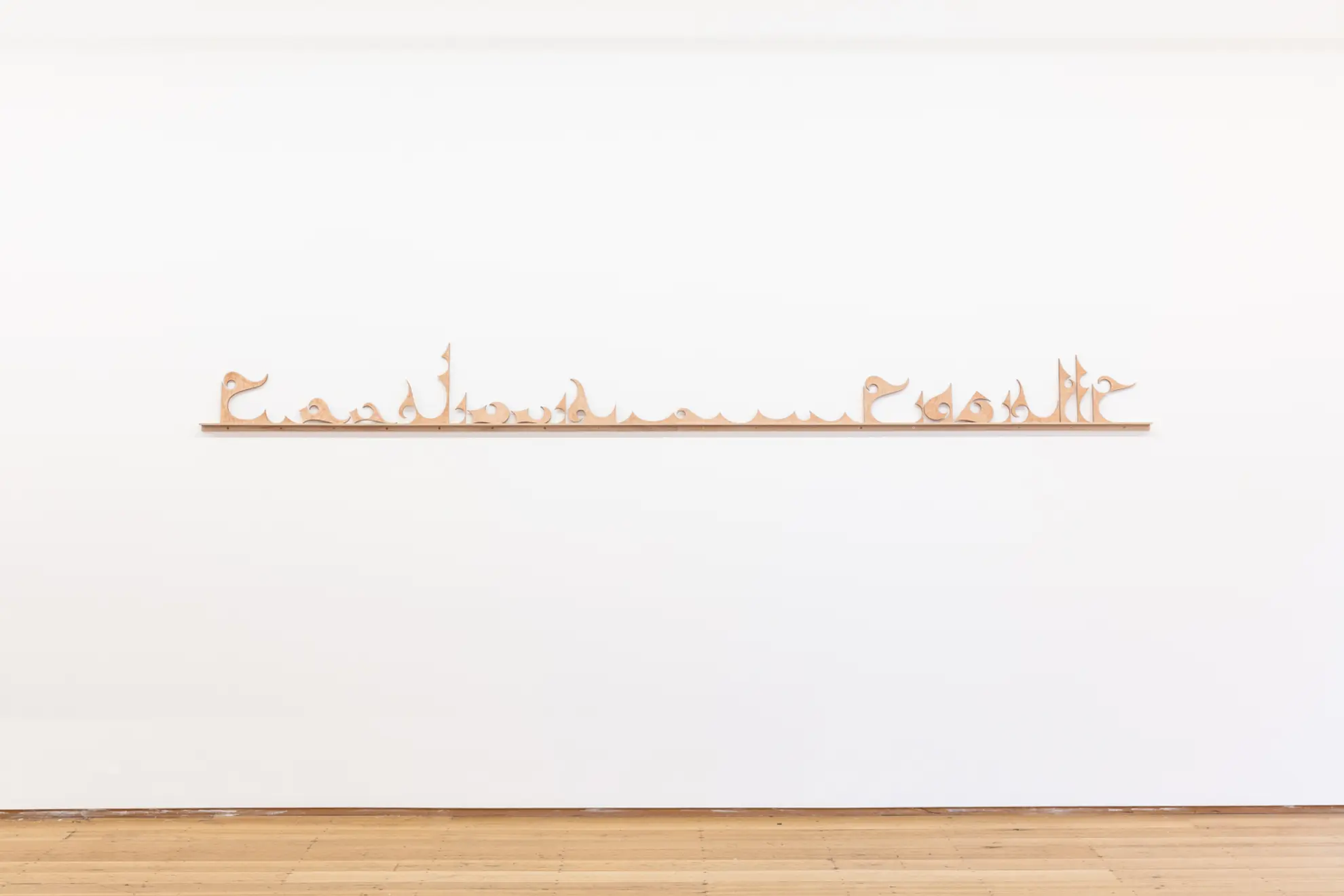
As you enter the gallery a long line of curved shapes make up Leitu Bonnici’s 2-22, 2-22. Originating from one of celebrated Samoan graphic designer Joseph Churchward’s typefaces, Bonnici breaks apart and abstracts the shapes of each letter in the typeface to create a wholly new language. This new design exposes the limitations of the English language and that perhaps as Moana people what can better describe our connections and kinship is a language that better reflects our oceanic lineages. Thus Bonnici creates a horizon-like installation of curving shapes, waves and arcs.
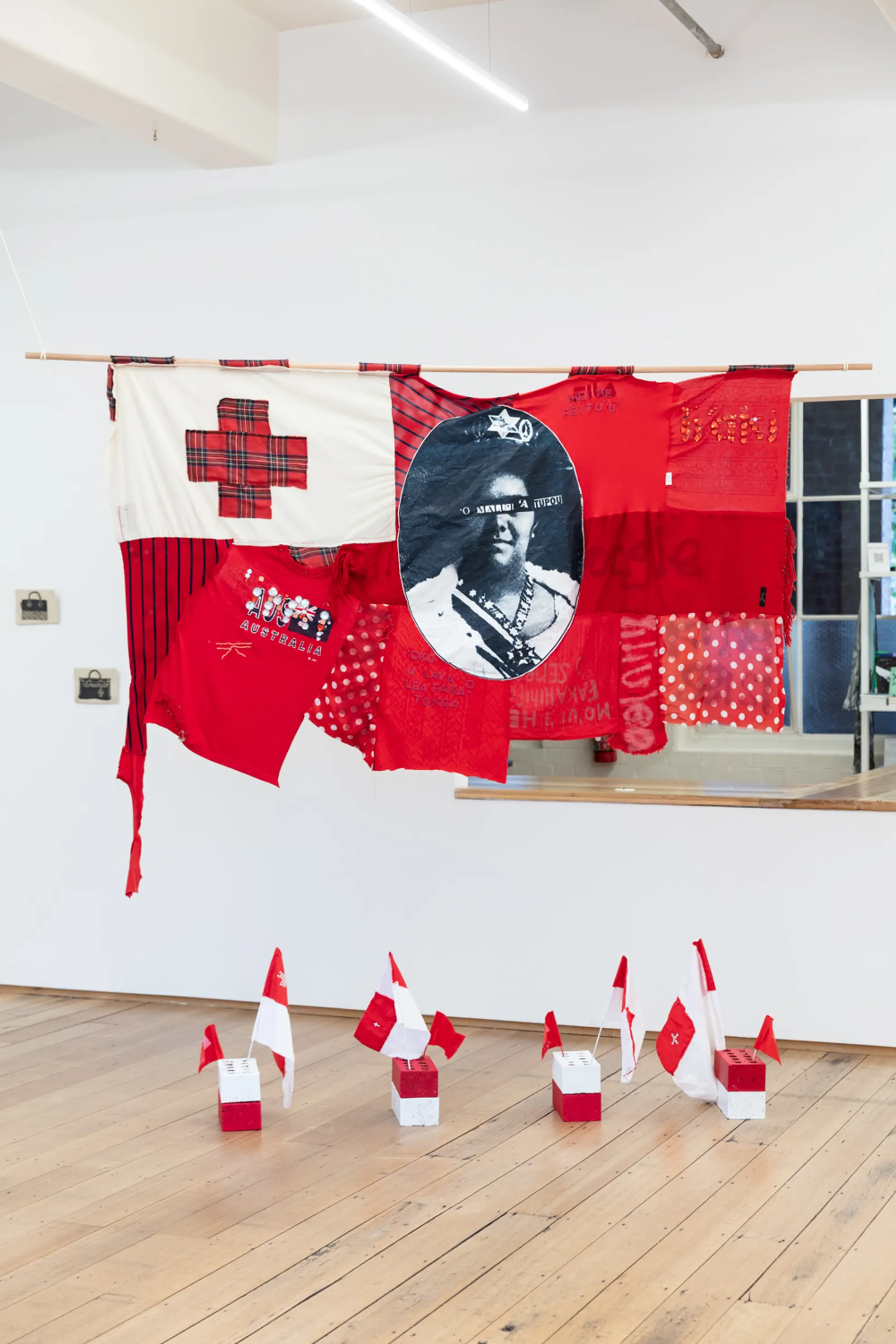
Flags are identifiers of nations, thoughts and how you connect with people and ideologies. For Emily Greenwood, who was raised removed from her Tongan heritage, the flag is an act of defiance. Pieced together with different fabrics, materials, jewel stickers and text, in the centre is a black and white image of a queen. With nods to DIY and punk culture this is no English queen however, instead the longest reigning Tongan monarch Queen Salote is featured. As the words overtop of her image say, ‘O MALU’I ‘A TUPOU or ‘protect Tupou’ - Tupou being the name of the reigning royal family in Tonga. God save Queen Salote indeed.
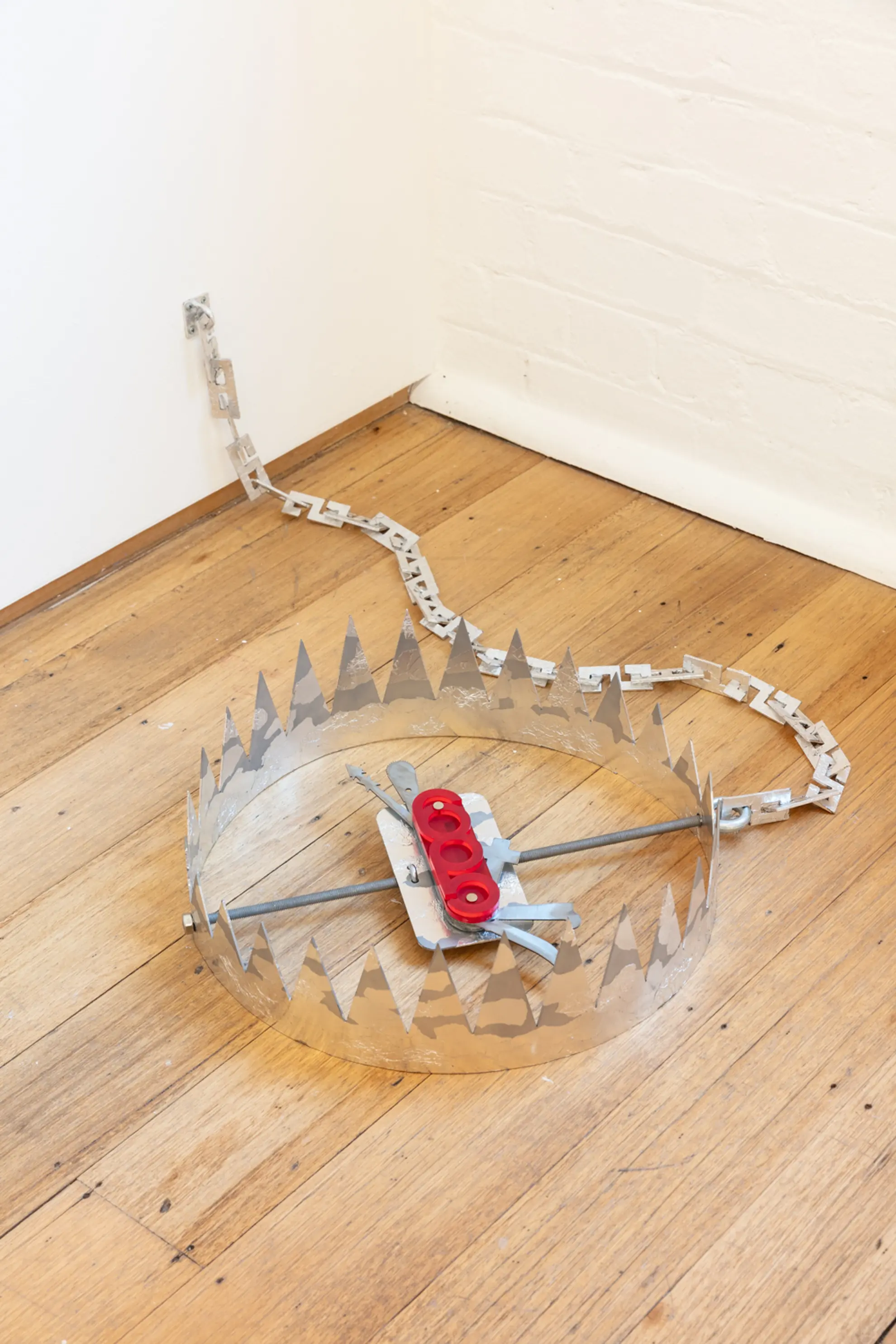
Another work that cleverly plays with the pressures and expectations of colonial structures is Axel Iva’s ‘OKI, an oversized pocket knife sitting gingerly within a trap. Inspired by his own experiences within the corporate world, Iva creates an object that can be used for protection when in those kinds of spaces. Each piece is a representation of Samoan culture, survival and resilience from the Nifo ‘Oti (Cane knife) to the Matatuai (Coconut Scraper), if Iva ever has to return then at least this time he will be prepared.
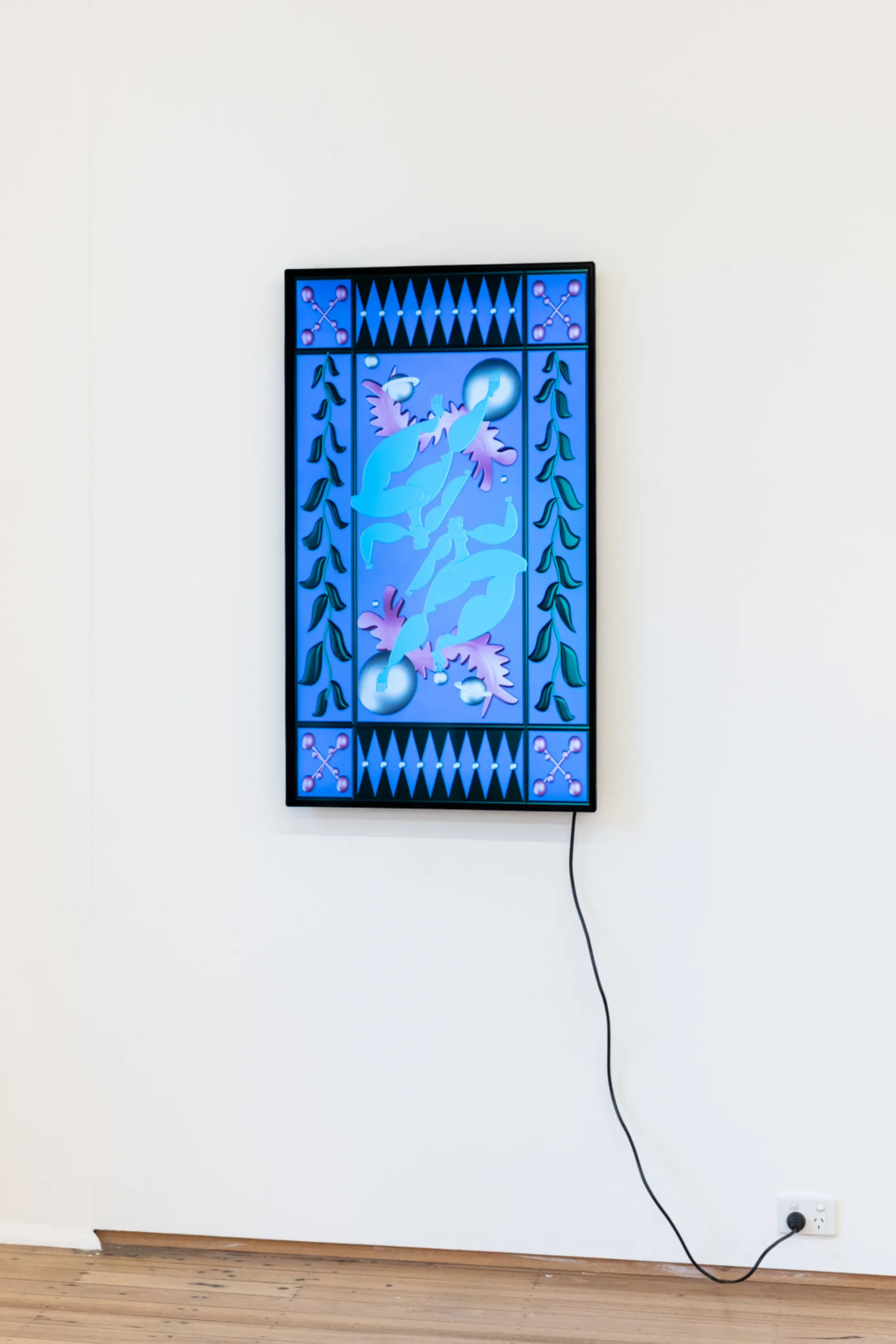
Digital technologies have been key for families to maintain connections between countries, growing from collect calls to social networking websites such as Bebo to FaceTime and TikTok. Etanah Lalau-Talapā’s work Loto Fa'afetai, Lota Fa'atuatua acknowledges this importance that it has held but also critiques its presence and how it can be at odds with traditional cultural systems. These digital spaces are not able to hold the complexities and nuances of the vā nor the depth with which ‘aiga and our many generations hold in society. What then are we losing while embracing our digital future?
As mentioned in the earlier parts of this essay, the ripples of the abundant land lie that was sold to Moana families is still felt today. Jimmy Ma’ia’i explores the Registered Seasonal Employment (RSE) and Pacific Australia Labour Mobility (PALM) schemes - a contemporary version of the work schemes from the past. By referencing materials from the orchards that these workers come to know well and combining them with Siapo patterns, Ma’ia’i explores the complicated nature of these contracts - financially supporting one's family while having to be away from them and their homelands for extensive periods of time.
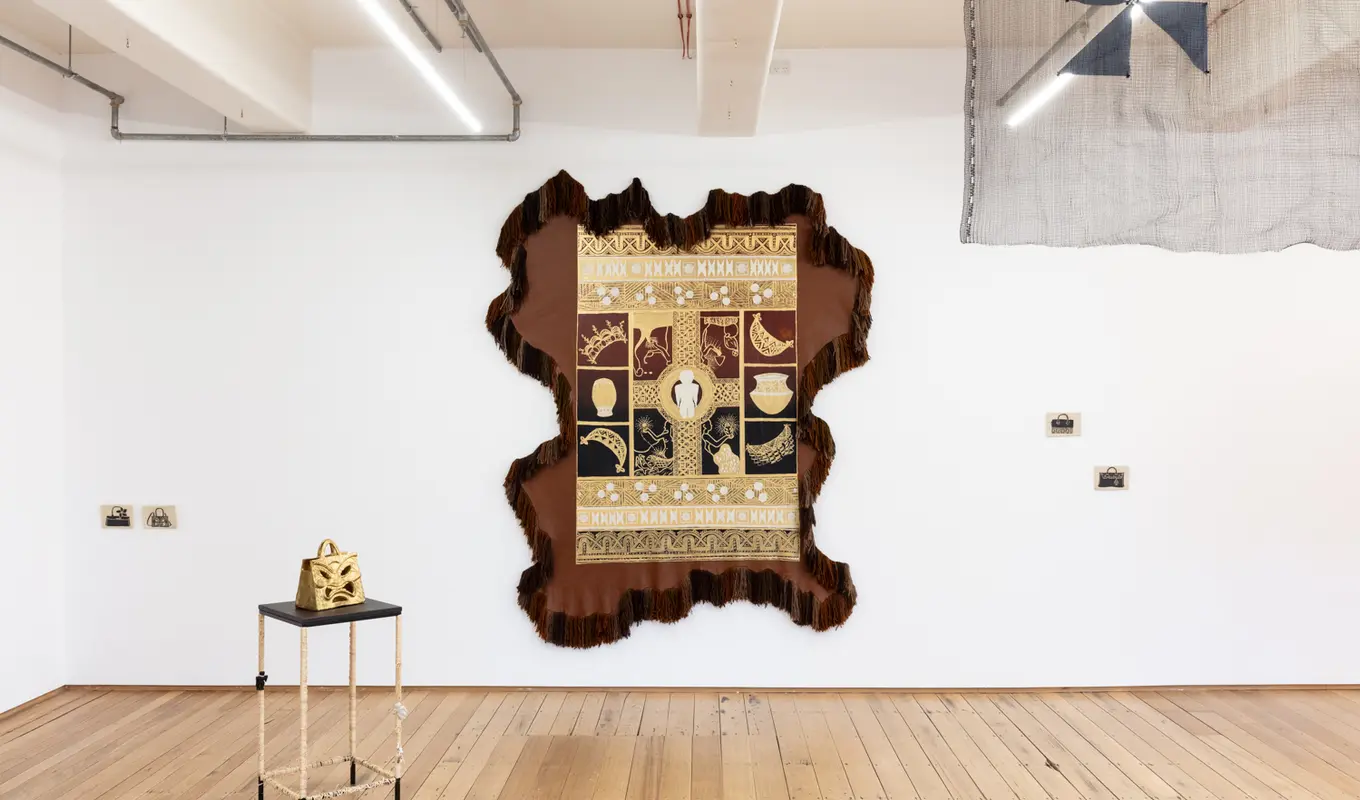
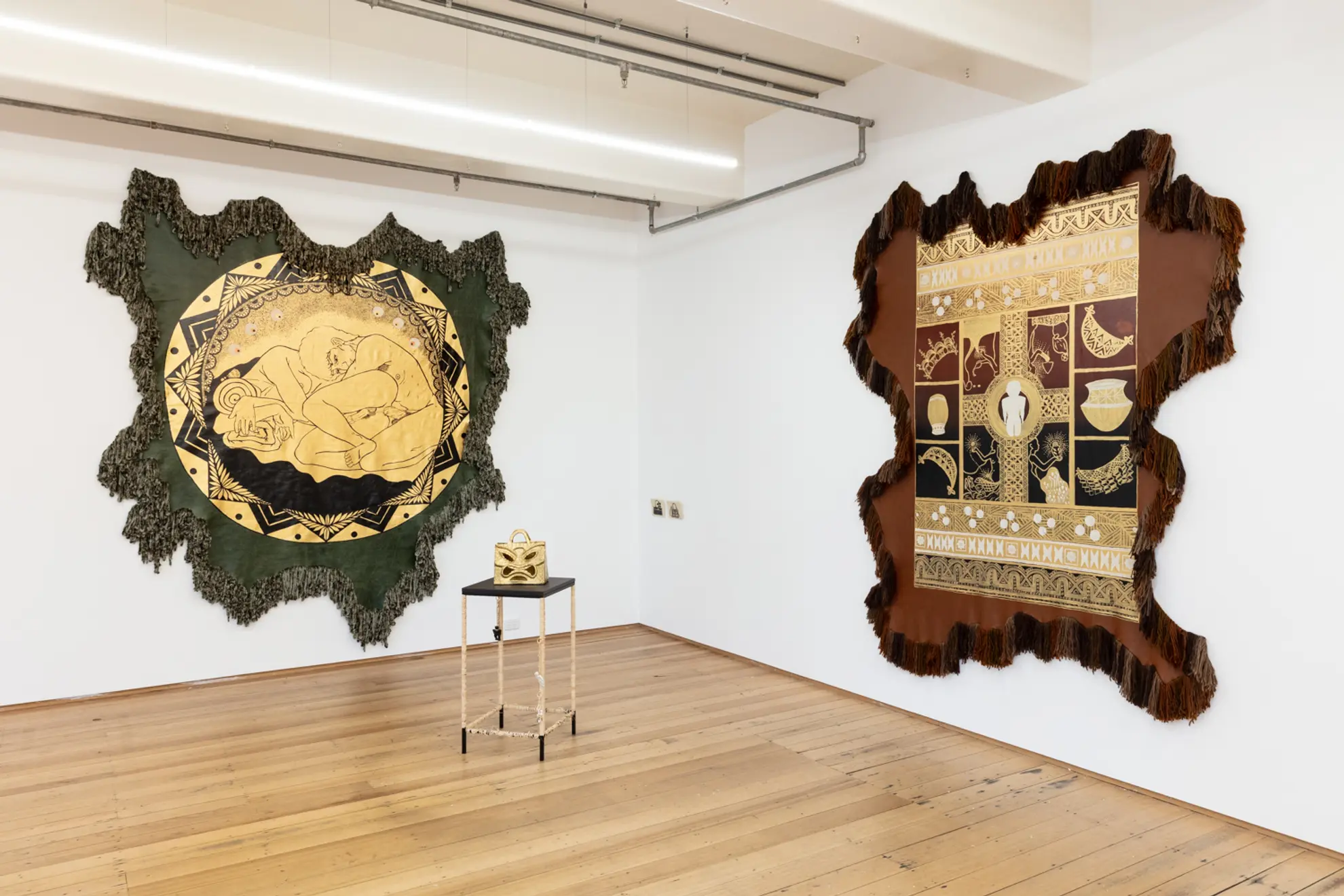
For some, the physical distance from our homelands does not hold such despair but instead offers hopeful futures and freedoms that are otherwise restricted. Manu Vaea’s large-scale works combine elements of the traditional Tongan ngatu and fala kulasi with contemporary materials such as leather, yarn and paint. This exploration of new materials is used as a way by Vaea for leitī to be represented in these cultural objects, asserting that leitī have and always will exist in Tonga and other Pacific nations. Vaea suggests that perhaps the diaspora is where leitī flourish, outside of the confines of bigoted minds and instead embraced in the openness of an experience free from the burdens of the past.
Although this group of artists and their practices have been cultivated in these ‘abundant’ lands they are not defined or beholden to such. They are not afraid of who they are and how they navigate this world, instead embracing their culture and connections to firmly state that Moana peoples will persevere no matter what history tells us.
Talia Smith is an artist and curator from Aotearoa based in Sydney. Smith is of Cook Island, Samoan and Pakeha heritage. She has curated exhibitions for organisations such as the Museum of Contemporary Art Sydney, Singapore International Photography Festival, IMA, UTS Gallery, MAMA Albury and Ballarat Foto Biennale among others. Her writing has appeared in publications such as Memo, Art New Zealand, artist catalogue essays and books. Smith has completed research residencies in Singapore, Germany and the Nordic region. She currently works as the Coordinator Programming at Blacktown Arts.