Sebastian Henry-Jones
“Fireplace and Khaled Chamma's broader practice”
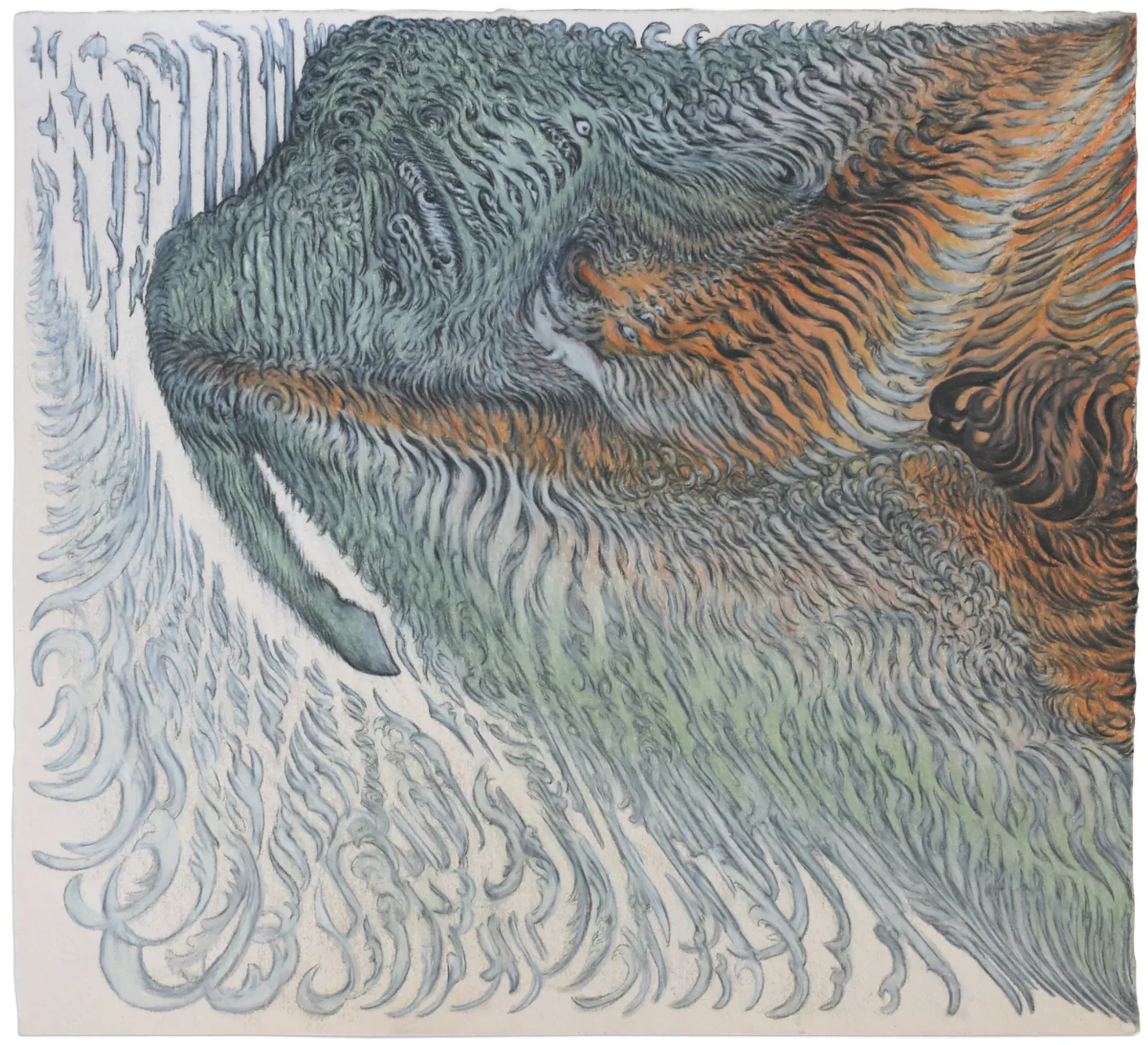
I met Khaled Chamma in 2022 when – in my role as judge – I selected him as the winner of the Brunswick Street Gallery’s Fifty Squared Art Prize. Khaled’s winning drawing, Summer Daydream, depicts what looks to be a tiger and perhaps an elephant or a horse, seen through bands of vibrations pulsing through the air, or maybe seen in the reflection of the rippling surface of a pond. Of the winning work I wrote:
“I was immediately drawn to Khaled's intricate Summer Daydream. Apart from evidencing a clear amount of skill and technical ability, Khaled's work presents a unique vision that breaks from any dominant artistic tradition. The world that this drawing conjures is at once intimate in its detail and infinitely expansive in its psychedelic repetition.
I can see Khaled’s well-honed technique taking many different forms and occupying a variety of spaces within the arts. This work demonstrates a strong visual practice, that with the momentum gained from receiving this prize, I would love to see evolve.”
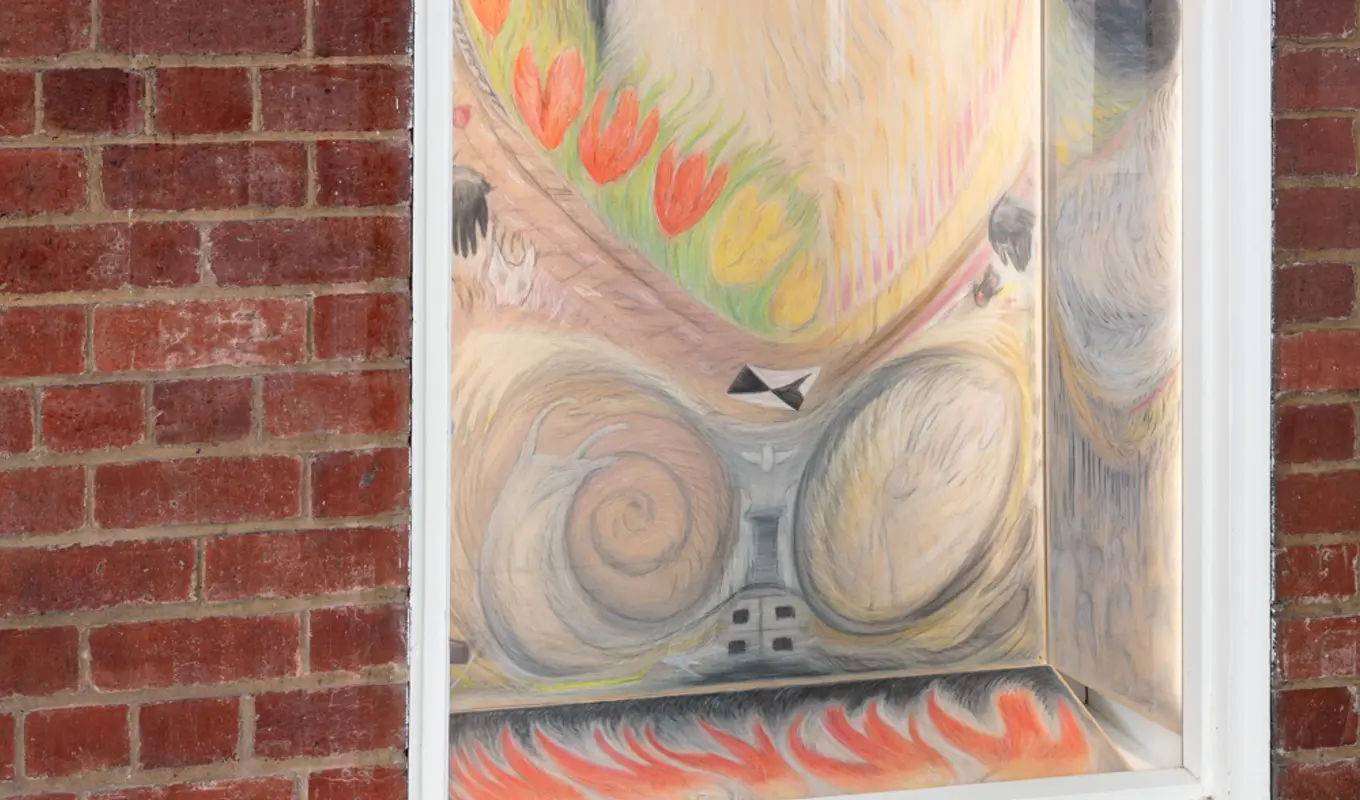
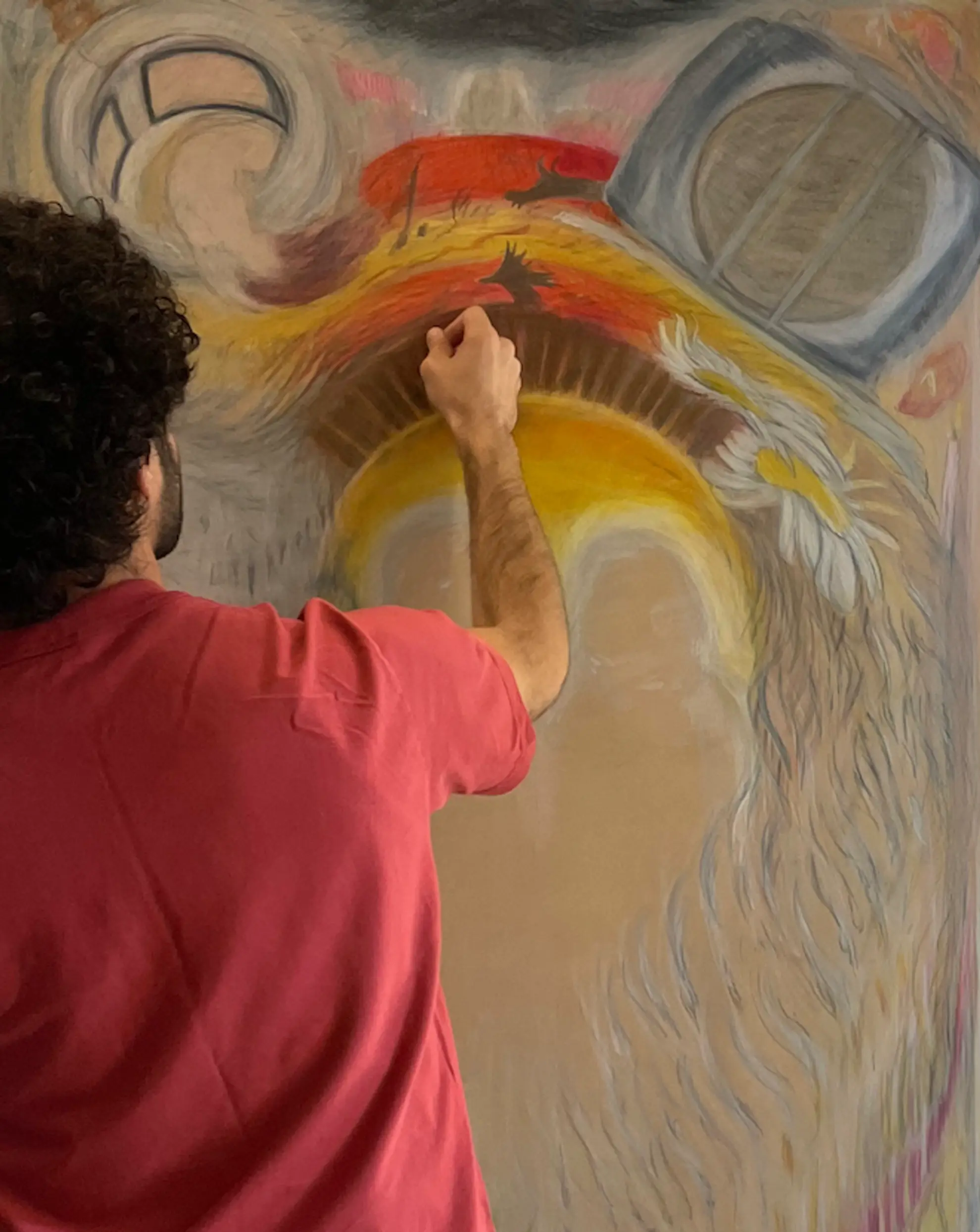
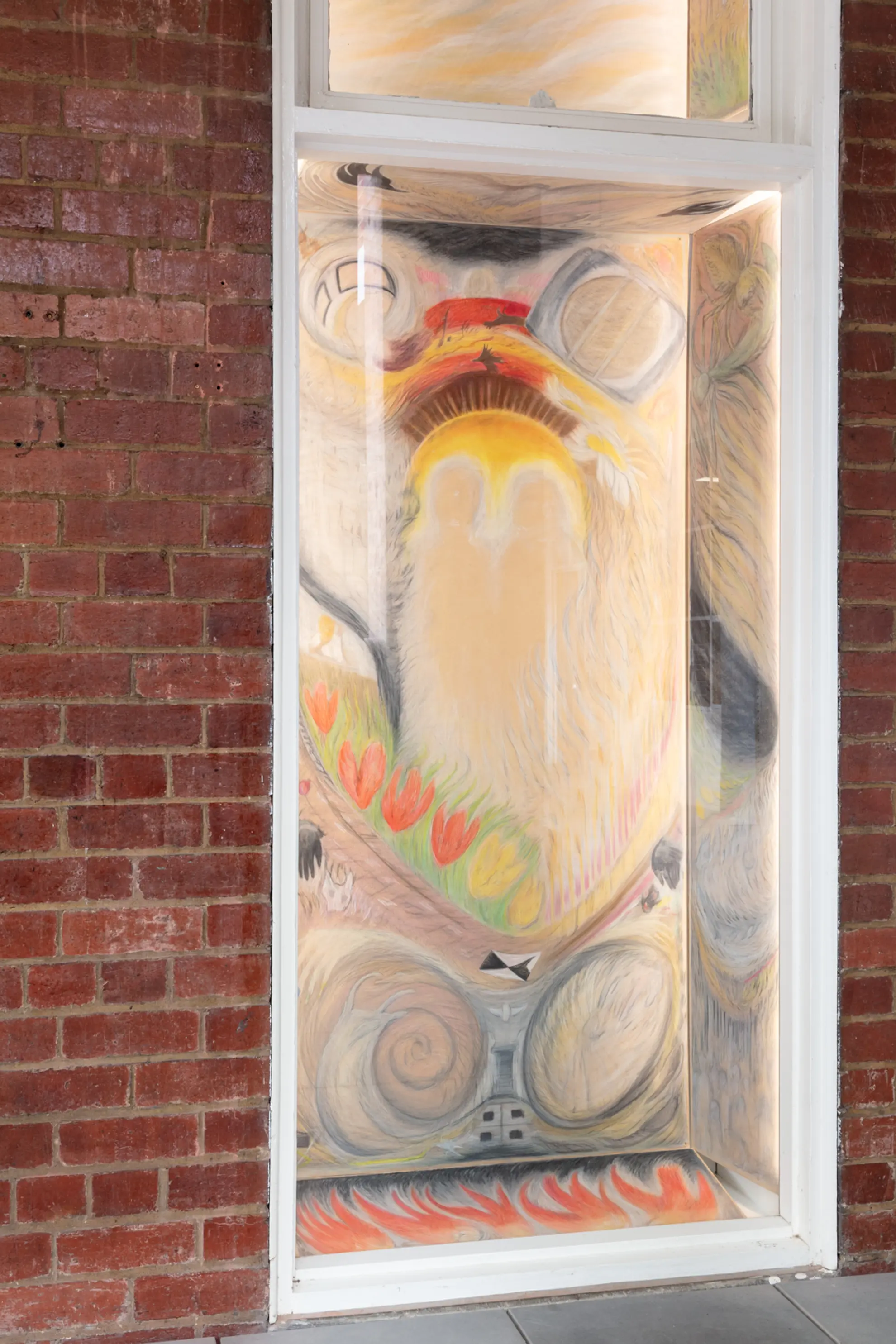
This was my first encounter with Khaled’s art. I begin with this story because Khaled’s current work in the West Space Window concerns itself with memories, and their tender aggregation as something fiercer than mere history. Fireplace is comprised of eight differently-sized panels of MDF, onto which Khaled has drawn images in his singular style that relate to memories of artworks seen at West Space since 2023. These are contextualised within memories, events and imaginations in his life outside of the gallery during the same period of time.
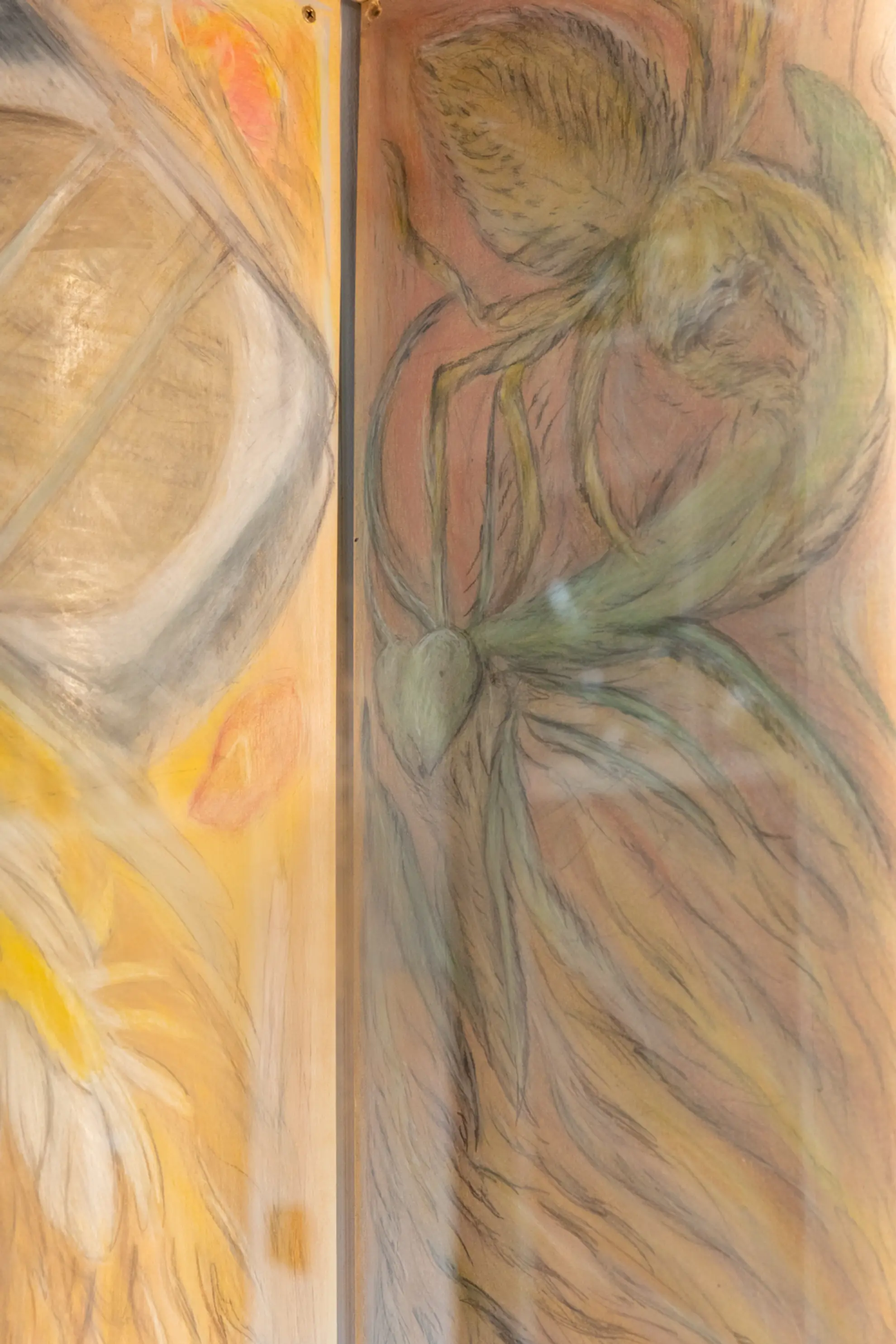
After sharing an early draft of this text with Khaled that included my memory of his Summer Daydream, he let me know that he had actually included a reference to that drawing at the top of the left side-panel, in the form of a yellow spider and praying mantis that he originally saw in his backyard. These figures eventually became the tiger and green horse that I saw in Summer Daydream.
Other recognisable works from my time as curator at West Space, encoded in Fireplace, include HOSSEI’s THUNDERBLOOM (2023) in the top, central panel; drawn as dark clouds above the work’s protagonist Nahid’s form; the large, yellow and red Batik work from Chris Ng’s Where You From? (2023); and wani toaishara’s a most beautiful experiment (2024), visible on the left of the large window in the form of a man holding a mask in front of his face. Juan Rodriguez Sandoval’s memorable West Space Window work from 2023, Yabby Estate, is also visible in the bottom right corner of the composition. These were all works that I had a direct involvement in presenting. Seeing them represented visually creates a different image of them in my head than the writing about them had previously done.
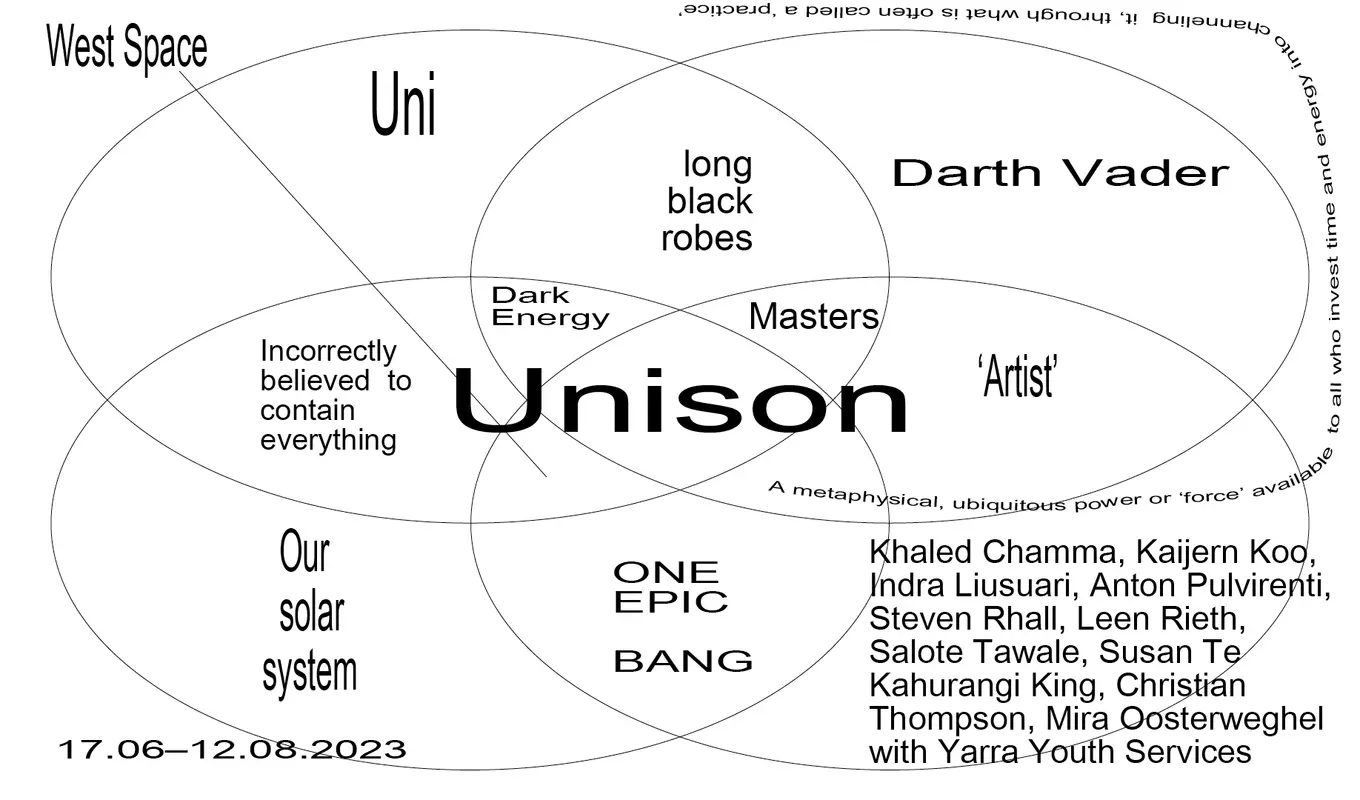
Khaled and I met after his Brunswick Street Gallery win, and went to the Picasso exhibition at the NGV a couple of weeks later. In the winter of 2023, I invited him to take part in a group show at West Space – a 30th anniversary exhibition titled Unison. As an artist not in regular circulation throughout Melbourne’s artist-run scene, Khaled was a good fit for a show that worked from the basic premise that art and culture can be so many things more than what the professionalised sphere of the visual arts tends to predetermine. My own reading of Fireplace reveals a nod to this show towards the bottom of the central panel, where a black and white rectangular form represents a large paper and ink work from Salote Tawale’s 2014 West Space show titled Colonising West Space, which was re-presented for Unison. After that exhibition, Khaled asked if he could become a regular volunteer at West Space. There are so many forms and motifs in Fireplace that remind me of the time that I spent at the organisation between his engagement as a volunteer, and when I finished up in early 2024.
Akil Ahamat’s Extinguishing Hope (2025) is represented by a large snail at the bottom of the central panel. The exhibition was made up of two mirrored video works and an a-synchronous soundtrack, to sketch out an imagined scenario in which the artist converses with a snail at the edge of a rave, perhaps somewhere in Sydney. Captured in its striking title, amongst other things, Extinguishing Hope was an exhibition about turning away from a blind belief in the liberal order that hope preserves, a framing not dissimilar to Lauren Berlandt’s Cruel Optimism. In its most cynical application, the instrumentalisation of hope within institutional settings would be understood as a means of garnering value from a liberal order that rewards such acts as radical politics.
In the past I had found it interesting that Khaled’s art was devoid of clear references to his strong political convictions, which the artist is tremendously vocal about. While his posting on Instagram slowly filled with social and geopolitical causes dear to Khaled, his art continued to be a place that the negative impact of humans and their actions could not touch. As Fireplace includes references to human activity, and elements of his biography, here then is an opportunity to reflect upon the huge changes that I observed Khaled make in his life to attune himself to a political identity that feels true to him in the wake of 7 October 2023, the ensuing genocide in Gaza and the current display of American Imperialism in Iran. In that time I have seen Khaled make the decision to really live his politics, partaking in direct action and regular protest, respectful discussion, and speaking directly to and at powerbrokers in the arts (and beyond) in a way that genuinely risks the linear progression of his professional life. Rather than speak rhetorically to a diffuse ‘other’ with a) a hyper awareness of how he might be perceived by his professional peers; b) without engaging with the actual substance of the views he endorses; to my mind Khaled; c) does not care if his politics might be perceived negatively by his peers or future employers, and; d) thinks carefully about the implications of the views he espouses for his broader worldview. I can see now that his politics haven’t been so legible in his art because he’s testing them out in the real world, through a practice of living that I greatly admire.
Fireplace is the first time that I have seen Khaled include biographical details and politics within his artistic world, a place usually reserved only for the depiction of animals and nature. The large silhouettes in the central panel represent the artist’s parents, while the sides of the large window depict a plane and a mass of faceless people; surely images relating to the evisceration and displacement of humans through warfare and conflict. As the title of this work might suggest, the whole thing is set ablaze by flames from below, rendered in the way that scrambling hands might be.
A work of heroic proportions in the manner of history painting, Fireplace is a visual composition that blends imagination with current affairs and personal conviction. I can imagine it taking up residence in some quiet part of a church. Introducing the work on Triple R’s SmartArts, Khaled said that through it he wanted to show his appreciation to the practice of art and of artists, and to the arts workers who make it possible. Amidst all that is happening off the canvas in the third decade of the 21st century, the simplicity of this devotional gesture is quite beautiful, and reminds me of the ability of art to move us, if we are willing to be moved.
Sebastian Henry-Jones' curatorial approach is led by a passion for DIY culture, and situated in the context provided by the gentrification of Sydney and Melbourne’s cultural landscapes.