McKenzie Wark
“Hermaphroditus Live: On Andrea Illés”
Take One
I’m watching the livestream of Andrea Illés' Dreem2 as I write this. It's daytime here, night in her world. There’s a hum of background noise and wind. Her body arched against a tall planter. There’s a light breeze, animating the leaves of the plant in the planter, and the trailing strands of Andrea’s costume. The position looks uncomfortable. She is supporting her own weight with her leg and back muscles. Her feet arch too, toes on the ground only. Is she wearing socks? She’s not wearing much.
I think of sex workers, holding their bodies in whatever shape pleases the client, counting the minutes. Maybe sex work and performance art are not all that different once you take away the divergent legal and financial dimensions. Both involved what Andrea calls the “capitalised body,” which makes me think of what Pierre Klossowski called “living money.”
Pierre Klossowski: “…institutions claim to defend individual liberties and the integrity of persons by substituting for the exchange of bodies an exchange of goods mediated by the neutral (and hence equivocal) sign of money. But beneath this circulation of wealth, money secretly ensures the exchange of bodies in the name (and in the interest) of these very institutions.”1
Andrea and I met on Zoom. She was in Paris; I was in New York. Somehow, we figured out time zones and got it together. We spoke, among other things, of the body and its value. Of the special value of certain transsexual bodies. That special money. On the street it’s pretty much worthless, but on a bed, that’s something else.
Part of Andrea’s exhibition no rock no flower involved her tearing fourteen mattresses apart, down to the wire mesh inside. She told me about the mattress as an ambivalent thing, seen from the perspective of the sex worker. For most people, the mattress connotes rest, comfort, security, sleep, snuggles. There’s few things I like better than to nest in bed with my girlfriend and the cat. To the sex worker, the mattress is a place of labor. Site of an exchange of the living money of the body for the dead money of the dollar.
The mattress torn down to its inner form seems more like a cage. That reduction is a modernist gesture. Shed anything in excess. The result is not the serenity of pure Platonist form but the menace of bare wire.
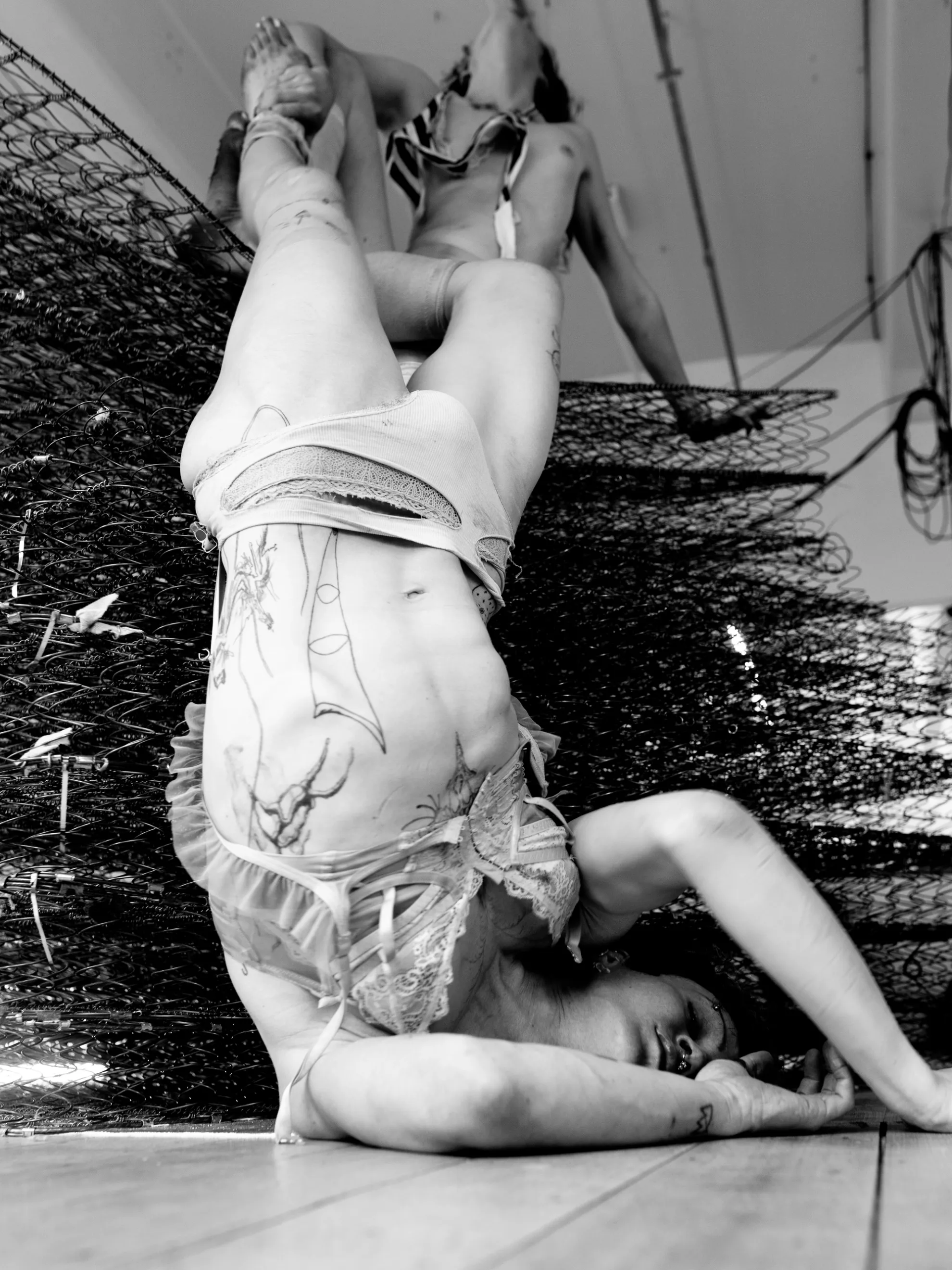
The figure of the transsexual woman, in literature and art, hovers between the exalted and debased. We’re special, never ordinary. Allegories of something, usually. Of modernity as promise or threat. Or in a more classical vein, of the power of the gods to overturn the order of the world.
Andrea and I spoke of the character of Georgette in Hubert Selby Jr’s classic beat novel Last Exit to Brooklyn (1964). Georgette is not special in the good way, she’s special in the abject way. Just a few pages into her story, she has a knife stuck in her leg. Andrea talks of reanimating this character. Selby has observed her closely. How she carries herself. Her every gesture. We can take her back from the cis gaze and make her our own. Her sisters too.
There’s no shortage of gender fuckery in classical art, too. The primal malleability of all things is a key to how myth works. Myth ends on the side of order, but for those of us who delve into that primal malleability, the richness of myth is in its beginnings. The modern transsexual, avatar of what science technology can engender, has her counterpart in the classics. We’ve always been here, one way or another.
The offspring of Aphrodite and Hermes, was, to nobody surprise, hot AF. The naiad Salamcis tried to rape him and prayed to be united with him. The gods heard her prayer, and the two became one, called Hermaphroditus. While the name became a now obsolete term for intersex people, I think of Hermaphroditus as an ancestor to modern trans women. There were cults in her honor, back in the day. Maybe we should have that kind of value again.
There’s a famous sculpture of Hermaphroditus sleeping. There’s a few copies, the most famous being in the Louve, lying on a mattress added later by Bernini. It’s a Roman sculpture in marble that is probably a copy of a much earlier Greek bronze work. She lies on her right side, on a mattress that is not hers, her head resting in the crook of her arm. From one side, we see her truly gorgeous ass and a hint of her right breast.
Andrea told me about going to see some of the Hermaphroditus sculptures in public collections while in Europe. Looking for clues, for ancestry, for a past she could claim. To me, the existence of these sculptures is evidence enough that even in the ancient world the girls knew how to feminize their bodies. Even if they did not know the science of hormones, they knew the art. That you can use the urine of pregnant mares to feminize the flesh. I think the various Hermaphroditus statues really are tranny porn, modelled from life.
Andrea on her modernist mattresses is Hermaphroditus brought up to date, and in the related register of performance art rather than porn. On display again as the sign of the transversality of the world, its sideways escape from any imposition of hierarchy and order. At one and the same time a goddess but also potentially (and I hope not, not ever) Georgette, knife in the leg just for wanting to be and be loved.
For a moment, maybe no more than a decade, there’s been lots of trans people living here in Bushwick, Brooklyn and neighboring Ridgewood, Queens to the point that sighting us on the street became ordinary. Not that there isn’t violence. We’re still devalued currency as living money in daily life. But still. Something ordinary. It’s a center for a flourishing culture, which is also an international thing. Trans people everywhere are making our own cultures, our own arts, away from and without the cis gaze.
Since we traverse the distinction, we pose again the quarrel between the ancients and the moderns. Are we avatars of myth or technology? Or maybe neither. Maybe we’re just one of the forms of ordinary being. About which Andrea Illés makes extraordinary art.
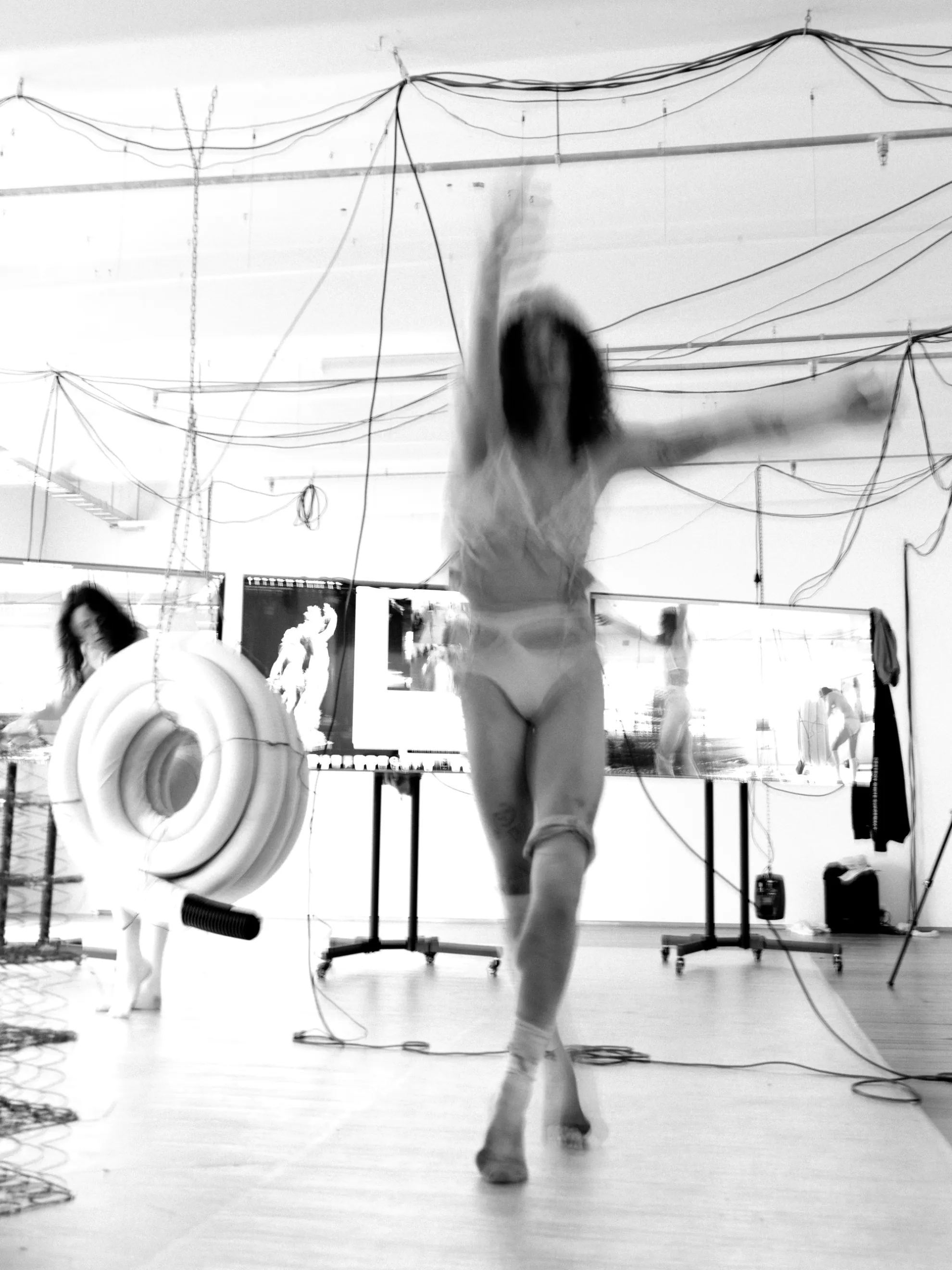
Take Two
I wrote the text above and sent it to Andrea. She read it. Asked to meet on zoom again. This time she is in Amsterdam, taking care of a friend. We talk of the things girls like us talk about, then talked about this text. Unfolding it, refolding it, to see what else might emerge between us, artist and writer.
The trans sex worker is a very particular kind of capitalized body. The archetypal figure of the hustler. The word hustle comes from the Dutch and means to shake or toss. While airborne in the thrumb of language, its acquired senses of pushing or jostling, hurrying and harrying. Getting what you want with a push, being pushy. Above and beyond the law. The sex worker is one of the hustler’s archetypal figures.
The sex worker, particularly the trans sex worker, engages the body both as labor but also as capital. The body is what is capitalized, value-added. Cash converted into keeping up appearances, and for the trans sex worker, accumulated for surgeries. You might think: Aha! The neoliberal subject! Yeah, sure, but what’s a girl to do. It’s not like she can get an office job or whatever. She invests in what she has.
The capitalized transsexual body is both under and over valued at the same time. It has value because desired. As I put it in the first text: has value in the sheets but not in the streets. Then Andrea says, “but a girl can make good money off the corner.” That complicates things. The thing is, a trans girl can have value in a lot of situations, and very few of them are safe. Devaluation—death—can be nearby. “On the corner between value and violence,” I suggest. And she’s like, “girl, write that down.”
The figure of the mattress also turns out to be complicated. Sometimes it’s the same mattress where the client fucks a girl too hard, and where she hangs with her beloved friends, safe, warm and happy. And it’s not as if sex work labor is all and only labor. There’s things to learn, appreciate. Sex workers know things.
Amara Moira: "Who people really are, that’s what sex workers see. People’s nakedness, their barest truest nakedness, is reserved for the true professional, only for those who know how to undress. The fleshy messiness of men isn’t often found in books (except this one, of course), but exists naked in our bedrooms, on all fours, begging us to put an end to the farce that is their life, even for a few minutes."2
There’s a kind of transversal connection between labor and nonlabor. The hustle lives at that confluence. The hustle is less about needs than about desires. The hustler turns a client’s desires into the means of meeting her necessities. And maybe some of her own desires too.
Andrea and I talked about Georgette. I had not grasped how much that character means to her. She is a star, so gorgeous, bright, sharp as bark. Not that the world allows for that. We marvel at Selby’s understanding of her, wonder who the model for her could have been. The way she invites the very men who had disrespected her, attacked her, to a party with other trans girls. The particular exchanges of wants and needs between dame and trade. The way the party rolls along, loses its spark as they all get hammered. The way Georgette “makes her own spotlight,” as Andrea says. Makes a night of it. Iconic.
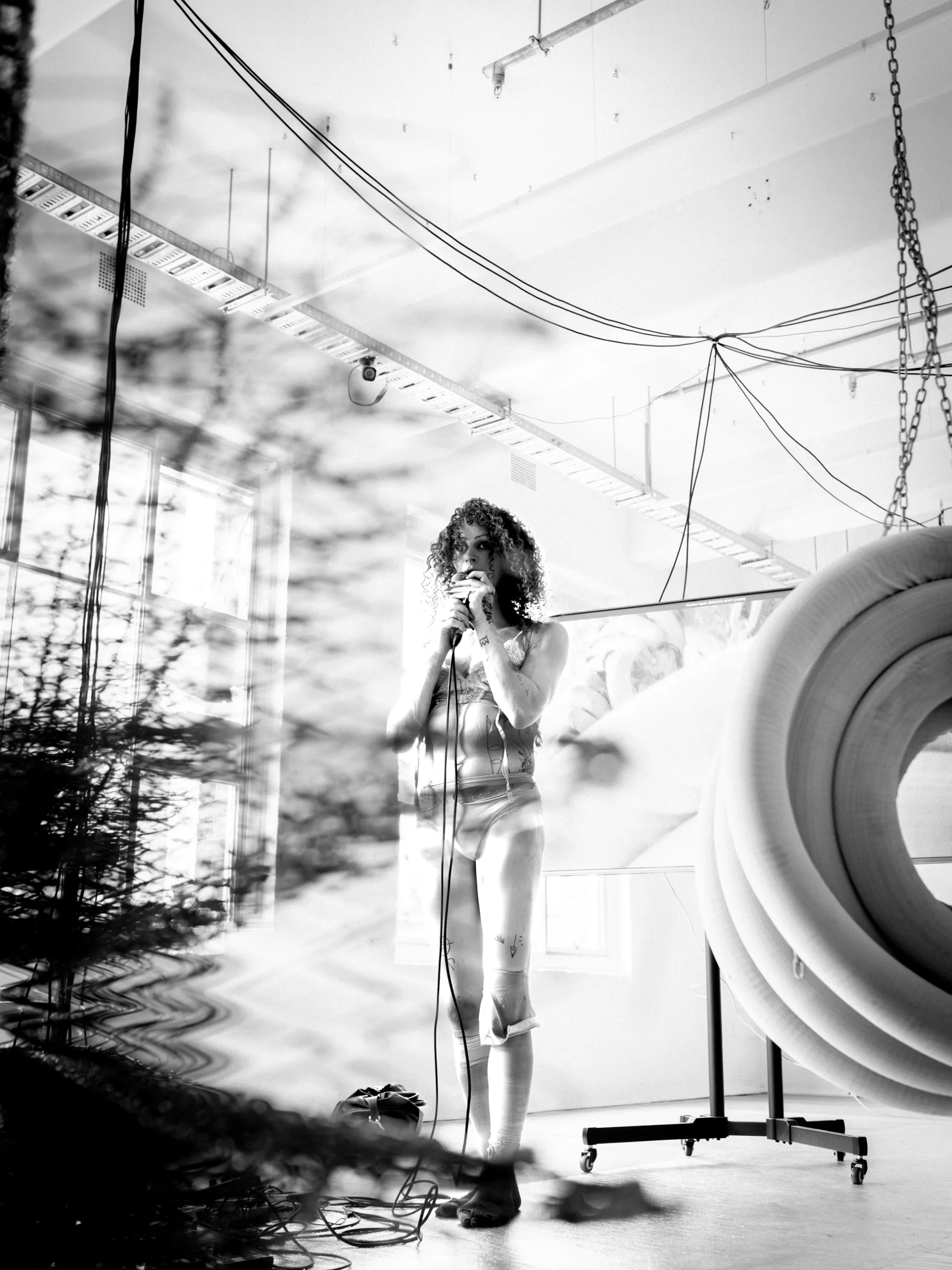
And we talk of Hermaphroditus. What I’d missed is the sacred character of the figure, for Andrea, and possibly for the ancients. The way the sacred and the erotic were much closer for the ancients, in ways Christendom and its secular descendants lost.
Andrea has seen two of the reclining figures and points out to me that you don’t exactly see the figure’s genitalia. It’s left ambiguous, as it should be. Clients often ask trans sex workers for dick pics. Which they would just jerk off to, so no dice. They should pay for that. Which brings us back to the capitalised body. The dick-having body feminizing itself, oddly adding to its value.
The trans sex worker and the trans performance artist seem to me both connected to the institution of money. Art and sex as desires money might allow a collector (whether of art-objects or orgasms) to pursue as money’s perverse other side. One side of money is this sort of neutral, indifferent, affectless kind of relation. The grey suit of calculation, exchange. Accumulation. Turn it over and all that is excluded from the intercourse of commerce becomes the commerce of intercourse.
There are worlds that clients and collectors will never know, where there can be different kinds of connection, not mediated by a fist full of limp bills. Our own little demimondes. Kiki in the stall, or quiet times in shared beds. Even girl-talk over Zoom, just between us. That these worlds exist and are closed is what creates the value of what is offered to the institutional world where money mediates and goes on its blank, indifferent way.
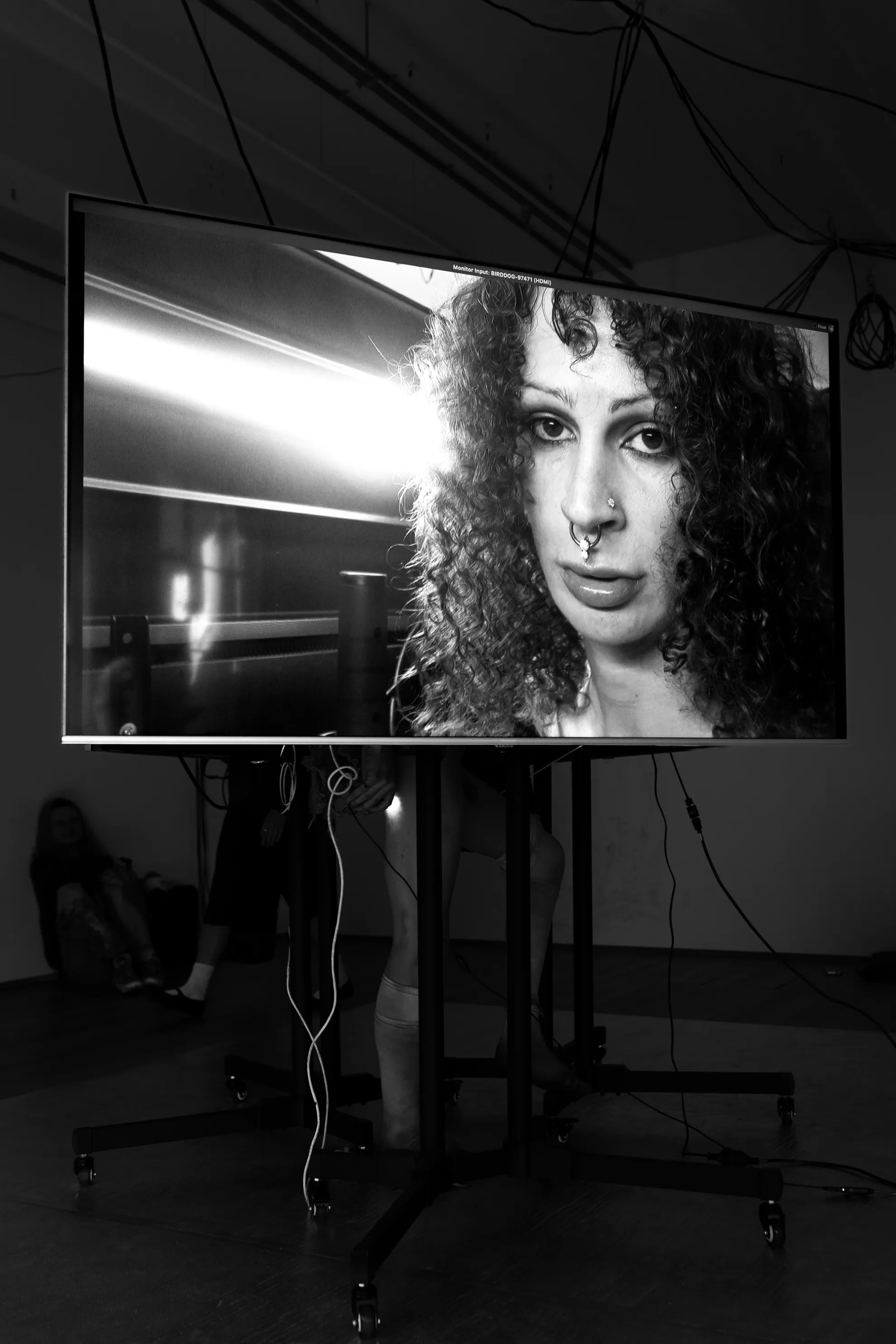
McKenzie Wark is an Australian-born writer, critical theorist, and Professor of Culture and Media at Eugene Lang College of Liberal Arts at The New School. In recent years, Wark’s writing has tended towards an autofictional register, taking sexual aesthetics, dissociation, and Wark’s own experience of coming out as a trans woman as starting points for theorizing new models of contemporary living. Wark’s self-described “auto-ethnography of the opacity of self,” Reverse Cowgirl traces her failed attempts at living as a gay man during the 1970s and ’80s and her subsequent journey towards life as a trans woman in the 2010s, employing a blend of low theory, personal recollection, and sex writing as tools for rethinking the narrative boundaries of trans life and literature.